
Unlike the elegantly over-the-top home, and now museum, of de Cerralbo, the relatively humble house of Sorolla is well known to the locals of Madrid, and it is growing in popularity for the average tourist. And after my recent visit, I can clearly see why. I am quickly discovering that no matter how prepared I am to be wowed with each new exploration, I am naive and never as prepared as I assume I am for the wonder. I do my research, peek at a few of the works online, and find each time, that nothing does the experience justice like the experience itself.

Jaoquin Sorolla y Bastida was born in Valencia in 1863 and died on August 10th, 1923. His parents died from cholera when he was two, leaving him and his younger sister, Concha, to be cared for by their aunt and uncle. He received a formal education in art from 1871 to 1881. There, his teachers encouraged him to paint outdoors, a skill he had come to refine perfectly over the years. At 18, he traveled to Madrid and studied the works within the Prado. Thereafter he spent four years studying under a grant in Rome, followed by a long passage of time in Paris.
In 1888, he married Clotilde García del Castillo, a woman he had met nearly a decade prior, while working in his father’s studio. They had three children between them, and he then spent the next decade in Madrid painting gigantic masterpieces to be displayed internationally in Madrid, Paris, Venice, Munich, Berlin, and Chicago.


His first reigning masterpieces, Another Marguerite, received a gold medal in Madrid and then first prize in Chicago, where it was thereafter acquired and donated to the Washington University Museum in St. Louis. For a brief period, he focused largely on social issues, reaching his peak of fame with the 1900 “Sad Inheritance” a painting of children crippled by Polio, bathing in Mediterranean. They say this was his last socially-conscious piece. Thereafter, his work turned largely towards that of portrait paintings. He had little passion for this type of work, but commissions were what brought in the money. His true joy came in painting his family, which was all the more obvious in their culmination.

In 1911, Sorolla visited the United States, displaying over 150 pieces at the St. Louis Art Museum, and over 160 at the Art Institute of Chicago. Thereafter he was commissioned to paint a variety of landscapes depicting life in Spain, and he traveled throughout the country to create the works. He became exhausted by the many endeavors, and while painting a portrait in his Madrid Garden in 1920, he suffered a stroke, paralyzing him for the remaining three years of his life. His works are now displayed worldwide, in museums and within private homes.
Sorolla’s home would be hard to miss, nestled between two imposing apartment complexes and its high, concrete fencing, if it were not for the parade of signage that lined the street and the people flocking around the entrance way. It is located on General Martinez Campos, and it is open from Tuesday through Saturday from 9:30 to 8:00 and on Sundays and Holidays from 10:00 to 3:00. It is 3.00 Euro to enter his wonderful home - and likely worth paying the price if it means beating the crowds. Otherwise it free after 2:00 on Saturdays and all day on Sundays. (It is always free for university students - take advantage!)

The start and end of one’s visit back into Sorolla’s life takes place within his gardens. After passing through a stone archway, you find yourself walking through three small courtyards filled with manicured hedges, orange trees, bronze statues, fountains and colorful tile work that makes me feel as if I had never left Seville. The crowds of Saturday afternoon lounge under the terrace on deep green benches, admiring the scenes and likely marveling at the talent they had encountered within the home.
The start and end of one’s visit back into Sorolla’s life takes place within his gardens. After passing through a stone archway, you find yourself walking through three small courtyards filled with manicured hedges, orange trees, bronze statues, fountains and colorful tile work that makes me feel as if I had never left Seville. The crowds of Saturday afternoon lounge under the terrace on deep green benches, admiring the scenes and likely marveling at the talent they had encountered within the home.

Helpful signs lead the way to the ticket/audio-guide counter and souvenir store, where we collected our free ticket stubs, peaked into a temporary, uninspiring, exhibit of painted porcelain dishes we cared little for, and headed out towards the main portion of the house.
Without further introduction, we immediately encountered his large, awe-inspiring work, lining deep red walls. there were about 12 works in total filling the small echoey room, and about 20 people sharing in the wonderment with us. Down the center of the room his medals and prizes and guidebooks from the many places he had exhibited his talents were proudly displayed. All-in-all, the choices for what works were present here, in one’s first understanding of the artist’s work, were excellent ones. Through 12 paintings ranging from a photographic-like depiction of a woman sitting on a stone floor with a sheet after a bath to a faceless group of individuals you felt like you were squinting at, I quickly sensed that this was a man of both pure talent, likely unmatched by anyone of his time, and of artistic genius. He knew how to paint the perfect “photograph,” but he was better than that - he knew how to paint feeling, movement, and light.

It started to become a little too crowded, and so we moved on into the next room. Once used as the space where Sorolla would display works he had for sale, the room mirrored its original look, with the wall space crowded by lovely paintings - now mostly of his wife and three children. Women in brilliantly white dresses carrying parasols and looking over garden terraces or sunny beach-fronts were common throughout his works, and his blurred edges allowed you to feel as if the people were coming to life. It allowed you to connect with each piece, and I, several times, found myself lost in the minds of the characters shown before me.


Then came the art studio. While the previous rooms were cozy, encased in moderate ceilings, and small parameters, the art studio was characterized by its uniquely high, vaulted ceilings, and the crowd echoed throughout the space. Whereas the previous room was dominated by women and children, the scenes on the paintings that covered even the highest parts of the wall here were often of beach-fronts and landscapes. A helpful sign noted that it was typical of artists of the time to adorn their walls with a variety of textures, and true to that practice, the occasional, small tapestry filled in the spaces around the paintings. A few easels were scattered throughout the room, and ornamental vases held a wide variety of paintbrushes, making it look as though Sorolla had just left for the day. In the far corner of the room, an indent of the wall showed post-card sized works he had done of a variety of images - gardens, portraits, crowds - all arranged by the stages of his life. It was not only nice to see the evolution (and perhaps decay) in the quality of his work all in one place, but it was also interesting to see the different items he used for his cavas. there were corrugated cardboard pieces and random slabs of wood in carelessly rough rectangular shapes. It gave me the impression of a man who carried an apron full of paints and brushes and could not resist the urge to color every monotone surface he encountered. It hinted at a man of passion who had true integrity when it came to his unique talents.

From here, we entered what seemed to be the main living area of the man’s home. After passing under a creaky wooden staircase and glimpsing at some interesting looking cabinet/chests that seem to show up in every old museum-turned-home, we entered a bright, white room with relatively few paintings. To the left, a “rotunda” brought light in from the Andalusian garden outside and was lined with busts of each of the Sorolla family household. Marble pillars separated this portion of the room from its remainder, where a bright mess of hanging lights in its center illuminated two circular clusters of chairs and couches. It was all elegant in its simplicity, and bright like his paintings.
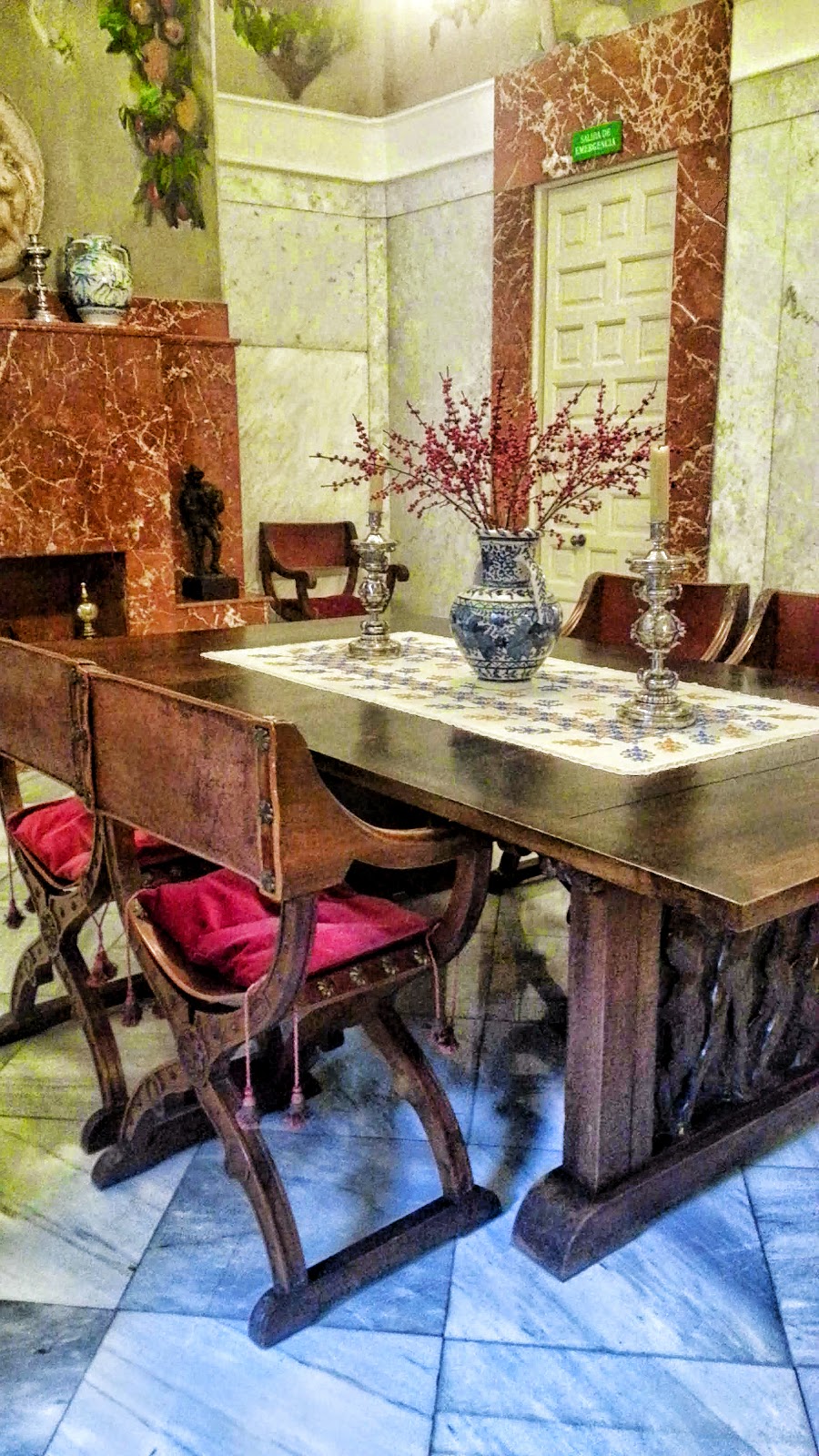 Next, we passed through a small, rectangular room of "azulejo" tiles modeled after King Philip II’s beloved Escorial into the dining room. it was the darkest of the rooms we had seen, with a mural of leafy vines and fruit held up by women dancing across the walls. A fireplace of marble sat at the end of the room, and to its right a window of green circular glass lit a sculptured scene near the above it. In a hall branching off of the dining room, likely into the Kitchen itself, hung a largely unnecessary number of Holy Water Fonts, and circling back near the entrance way of this room we found a painting of the room itself.


 Our final stop was the temporary exhibit called Trazos en la Arena, located in the series of rooms at the top of the creaky wooden staircase. Naked children dancing in the sand and brilliant sailboats were brought to life before me in his work. The glare of the sun seemed to leap out of each scene, and my eyes instinctively squinted to prevent them from watering. The cool, flowing water made me thirsty in the warm dry rooms. I wanted to be one of the liberated and seemingly carefree children on the warm beach sands, and I wanted to know what the boy “making eyes” at the bashful woman was saying to her as her feet became tangled in the fish nets.


I came to Sorolla expecting to be pleased, and I left converted. Having once marveled at the perfection and details of the Renaissance Paintings within the Prado, Sorolla taught me in a couple of short hours how reality is sometimes best depicted through imperfections, minimalism, and light. Instead of showing the viewer an individual’s expressions through exact replicas of their face and body - something he clearly was capable of - Sorolla let on-looker’s feel his character’s whole story, and often without much effort towards making a face. I highly recommend visiting this small home of brilliant work. If you are never lucky enough to visit Madrid, “no pasa nada.” This talented man’s work is endemic, and you just need to take the worthwhile effort to seek it out. But be warned; it may raise your standards, to finding imperfections in exactness of art.


