Translate

Showing posts with label Museum. Show all posts

June 19, 2015

Hanging out in Cuenca


Why anyone would decide, of their own volition, to build a house supported by, well nothing, is beyond me. But several people did decide to do just that, and it is for that reason Jonny and I took the 45-minute high-speed train to Cuenca for a day-trip.


Cuenca was an uninhabited region until the Muslims captured the area in 714 and viewed it as a highly strategic location. They built a fortress there, and they called it “Kunka.” The area quickly became a city known for its manufacturing and agriculture, and it grew prosperously. Then, starting in the 11th century and continuing through the 12th century, the area became hotly disputed. The Reconquista was spreading, and in 1177, the area fell to Alfonso VIII. Textile manufacturing and livestock helped the region continue to prosper, and no surprise here, a Cathedral was built.


When Carlos IV forbade textile industries in the 18th Century in order to prevent competition with Royal Tapestry Factory, Cuenca’s economy, and thus its population, declined dramatically, only to be made worse by the war for independence against Napoleon’s troops, whereby the city itself was largely destroyed. It was not until railroads were built in the 19th century and the timber industry began to succeed that Cuenca saw any form of hope. But then, in 1874 another war affected this once overlooked region. The city was taken over by Carlist troops during the Third Carlist War and the damaged city descended into a further state of disrepair.


To mark the beginning of the turbulent 20th Century, the Cathedral’s towers collapsed, affected most of the facade of the building. The century progressed forward with rural poverty and violent attacks on the Church, including murders of its members. During the Spanish Civil War, the city became part of the republican zone and was taken in 1938 by Franco’s troops. Post-war saw many of its inhabitants emigrating to northern Spanish regions and other countries. The city finally started to recover in the 1960’s and it even began to extend its territorial limits. The population and economy are now seeing signs of growth with an influx of tourism. It was declared a World Heritage Site in 1996 and continues to see promises of growth in the future.


When we first arrived by train, we disembarked from a small station and had to take a bus to the actual city. When Jonny made our plans for this trip, the information he had indicated we could take a bus straight to the heart of the old city from the train station. In reality, we rode the bus to the end of its line, and we were dumped off in some shabby and worn down neighborhood. The plastic on the multi-colored storefront signs were chipped. Graffiti, as usual, painted our way. Most buildings seemed in desperate need of a fresh paint job – or simply demolition. Was this the Cuenca people raved about? Surely not. The one upside – pale pink signs guiding our way towards the “Casas Colgadas” (Hanging houses) with ease. We wandered through this less than charming area, miffed, until we finally started seeing signs of hope, as we drew closer to where we meant to be, houses began to line the steep cliffs that towered over us. Now this was the adventure we were looking for. A tiny stream of the clearest water guided us to the start of a steep incline. We grabbed a map from the helpful tourist cubicle, braced ourselves, and began to trudge up the hill.


So the walk was not nearly as bad as I thought it was going to be, but it was a hill, nonetheless. It was worth every step, and the breathtaking sights I encountered made me forget any strain on my legs or sweat on my back. We had finally arrived.


Standing at the top of the hill, we paused to marvel at the picturesque buildings that had drawn us to this humble city in the first place – the hanging houses. The hanging houses (Las Casas Colgadas) were built over the steep rocks that descend into the Huecar River gorge in the 15th century. The three that have come to symbolize Cuenca are all that remain of this once-common living arrangement. Now they are a restaurant and an abstract art museum, and other than the great views of and from them, there was not too much more to say or think about them. I wondered what else we would do with the remaining seven or so hours in this small town, when we had taken in the sights before lunchtime. I quickly discovered that these houses may draw people in, but there is so much more that Cuenca has to offer – we just had to cross an ominous bridge to get there.


The Puente de San Pablo (Bridge of Saint Paul) was originally built between 1533 and 1589 over the gorge defining this city, in an attempt connect the Convent of St. Paul to the rest of the old town. It was made of stone, and probably would have given the one in Ronda a run for its money. When the original bridge collapsed in the early 1900’s (something Jonny was smart enough to talk about after we crossed it) the one that is now standing was constructed, this time made out of wood and iron, and supported by the remnants of the old bridge. It stands forty meters high, and upon looking down into the gorge, its subtle movements gave me an intense bout of vertigo. But oh my, the views.


After that high adrenaline walk, we had officially made it to the old city and it was time to explore. Passing through an old archway and through a quiet plaza, we found our way into Plaza Mayor, a long square entered through an impressive archway with a road passing through it and less than impressive restaurants marking its path (never eat in a plaza). One building impossible to overlook was Cuenca Cathedral.


As mentioned earlier, Cuenca Cathedral was built between 1182 and 1270, with its front walls and towers being rebuilt in 1902 after they had collapsed. Alfonso VIII’s wife Eleanor had a strong influence on its design, and it was created in the Anglo-Norman Style (think a high, flat, false front with towers). I was not keen on visiting yet another Cathedral. This country has too many and no matter how hard I try to distinguish the beauty of each one in my mind, they all run together in an overwhelming cacophony of vaulted ceilings, elaborate choir stalls, demonic looking cherubs, titanic stone pillars, over-the-top naves with their majestic domes, and so on. Too many chapels, too much history, it all is a blur.


But this one seemed different. The outside of it, though it had already been seen in pictures, impressed us, and before we knew it we were paying to see what else was inside. I am glad we did.


The Cathedral had a slightly different layout, some crazy ceilings, an easy to listen to audio guide, and best of all, a live choir rehearsing, filling the air with angelic and uplifting music that set the mood perfectly.


Several renovations were made to the building over the centuries, but my favorite addition to this 12th century Cathedral was the stained glass windows put in place in the early 1900s. The city had a competition among artists for the best ones, and several designs were chosen, meaning they were not perfectly harmonious. They also were more abstract, seeming to align with the strange feel of this town. The winners for me were these wavy blocks whose colors evolved in an ombre style, and when the sunlight hit them, they filled the room with their color like those of Sagrada Familia. It was ethereal.


After lunch, we decided to cool off in the tunnels of Cuenca.


We saw a couple of pictures of these tunnels on a brochure we had received, and I think we were both pretty excited to see what lie within this mysterious surprise. We picked up our tickets at the Tourist Center located just outside of the Plaza Mayor (note - it closes for a nice long lunch), and waited until five minutes before our scheduled tour to line up down the hill in front of an iron door built into a cliff along a decently busy road. We handed over our tickets, donned our hairnets and hardhats (a good idea in retrospect because I repeatedly whacked my head on the walls as I looked around), and in no time our tour began… Our all-Spanish tour, in a very heavy Spanish slur, by a very quiet-voiced woman, with a crying baby echoing down the bare stone walls. My Spanish got us nowhere and for the very limited and disappointing walk in the naturally air conditioned tunnels, we stared blankly at the rambling woman while I eyed with suspicion some rather creepy spider webs. After each 10 minute section of her speech I would turn to my expectant husband, standing ready to be impressed with my translations and information and tell him “there were aqueducts.”  He was not impressed. It was fairly cheap to get in - less than €3.00 - but essentially a disappointment for how short it was and how uninformed we were when we stepped back out into the glare of the evening sun. 


Our next stop was one we would not have decided to endure, but for the fact that we had purchased a tourist card pass, and it was included on there. We popped into the Museo de Semana Santa, saw a multitude of pewter staff-toppers, watched videos of Holy week processions, and in less than twenty minutes we departing from the three-roomed museum, heading to our next destination.  


Our day was quickly drawing to a close, and aside from wandering the beautiful streets of Cuenca with their narrowed roads, colorful and tall buildings, and charming old Spanish men, we had one more stop to make – Museo de Arte Abstracto Español (Museum of Spanish Abstract Art), located in one of the beautiful hanging houses that had greeted us that morning.


The Museum was opened by artist Fernando Zobel in July of 1966 after restoring the home to house his collection of paintings and sculptures spanning the 1950’s and 1960’s. It originated with a collection of a dozen sculptures, a hundred paintings, and scrupulous care over which works would be chosen for exhibition. Contrary to the traditions of other museums, this one was very selective about the donations it would receive, focusing on quality over quantity. Through a series of mergers and purchases, the museum, and its collection, expanded greatly, and the permanent works are rotated through. An average of 40,000 visitors stop by the museum each year, but for me it is hard to tell whether that is because of the art, or the location.


I have to say, I did not really enjoy most of the art here. I thought I would have been ready after the lessons learned from Bilbao’s beautiful and strange works. However, this just did not affect me in the same way. Some of the paintings were cool, most of the sculptures were obscure. The building, however, was worth paying to go in, with its beautiful views dangling over the gorge and its labyrinth of white walls and staircases. Unfortunately, you cannot stand out on the terrifying balcony separating you from a 40 meter drop into rocks and trees (trust me, Jonny tried). But again, the views are excellent.


Cuenca was humble, charming, and fairytale-esque. It took me by surprise with every corner we turned and each threshold we crossed. If I could do it again, I would always visit the Cathedral, and I would forego every other stop we made, but only because wandering the streets was enough marvel and enjoyment to fill a lifetime, and museums were just museums.


April 14, 2015

Pais Vasco Part II - The Guggenheim Museum

If your wanderlust leads you to Bilbao, you will no doubt take that rare opportunity to visit one of the world's best contemporary art museums - The Guggenheim! I was not sure how I would feel about this place at first, or if it was worth the €11.00 to go inside (€6.00 for students - and I do not think they check ages!). Many reviews said it was not. Having taken the chance, I can honestly say, they are wrong - it was worth every euro-cent. It is also worth its own blog post! Come with an open mind - and comfortable shoes. Listen to the audio guides - though not all of them because that would take days you do not have. Most importantly, have fun getting lost in an alternative world of mind-boggling, terrifying, and humorous artwork. 


The Guggenheim Museum Bilbao is one of four famous institutions (one in New York, one in Venice, and one in Berlin) funded by the Solomon R. Guggenheim Foundation to display and educate the general public about modern and contemporary art. In 1991, suffering economic decline in the Bilbao industrial region, the Basque government proposed to the Guggenheim Foundation that it would fund the $ 100 million construction of an institution, establish a $ 50 million acquisition fund, pay a fee of $ 20 million to the Guggenheim Foundation and subsidize the annual museum budget of $ 12 million. In  exchange for this multi-million-dollar expenditure, the Guggenheim Foundation agreed to manage the museum, organize temporary exhibitions, and rotate its permanent collections through the site.


Frank Gehry, a Canadian-American architect renowned for his deconstructivist or neo-baroque style, was selected to design the building. Much like anything he has created, this building matches the art it holds by thinking far outside the box. Gehry’s first sketch of the titanium complex was, in reality a doodled line drawing on a hotel notepad. He made his therapeutic musings a reality through innovative technology: to make the bricks match the curves he sketched and seemingly defy all laws of physics, they were computer generated, and then cut with precision using the computer design. No two bricks were the same, and each fit like a glove. Not only did Gehry continue to defy architectural odds with his Guggenheim creation, he also came in under budget, with construction costs totaling $ 89 million. The museum was inaugurated by King Juan Carlos I in October of 1997. Nearly four million tourists patronized the museum before it was three years old, resulting in €500 million in economic activity for the area, not counting the €100 million in tax revenue it attributed to tourist growth. The Guggenheim Museum is now regarded as one of the most important architectural works in modern times, and rightly so.


Outside the museum, a few structures are worth pause and analysis. When arriving from the city center, your first understanding of what you are about to experience manifests itself with the confrontation of an intimidating, spindly-legged arachnid.


Maman (French for "Mother") is a sculpture composed of bronze, stainless steel, and marble, created by Louise Bourgeois in 1999. Standing over 30 feet tall, the work evoked fear in me as I contemplated the idea of it coming to life. To me, it seemed to be a monster - the exact opposite of what the artist had truly intended. Louise Bourgeois lost her mother - and her best friend - when she was just 21 years old. The spider was an ode to her mother, a strong yet fragile individual, a weaver, and her protector.


We continued our stroll along the perimeter, and things became more abstract. The Tall Tree and the Eye by Anish Kapoor (inaugurated in 2009) was situated on a platform in the shallow pool separating us from the museum. A steel structure of 76 reflective, polished spheres spiraling 15 meters into the air in a chaotic fashion, the structure reminds me of magnetic marbles I used to have as a child.


Ready for a more friendly, less abstract visualization, we rounded the corner of the museum and headed towards its main entrance were Puppy by Jeff Koons awaited our affection. Puppy is a West Highland White Terrier, bathed in a variety of flowers, and standing 43 feet tall. The work was originally commissioned for Arolsen Castle in Germany in 1992. Then, in 1995, it was dismantled and reassembled at the Museum of Contemporary Art in Sydney Harbour, this time with a few upgrades - an irrigation system (which, to us, made the cute creature look like it was slobbering over its guests as water dripped from its chin) and an increase in plants, from 20,000 to 60,000. In 1997, it was purchased by the Guggenheim Foundation to be placed at its Bilbao location, and its most recent vacation was in 2000 at the Rockefeller Center in New York City.


Koons receives a decent amount of criticism for his art, which seems to carry a more simplistic, commercialized view of the world around it. He has made clear in interviews that he has no interest in hiding some deeper meaning in his works - that what you see and feel is what you get. I guess when people are used to spiders representing mothers and metal orbs representing - well, I am not sure I ever managed to understand that one - they become critical of superficial understandings and shallow pleasures such as joy or nostalgia. Refined art critics say the work juxtaposes the elite with mass culture by blending the concepts of topiary and dog breeding with that of chia pets and Hallmark greeting cards. The only juxtaposition for me was terribly wanting a puppy, and not yet having one.


Koons work is not limited to plants. He did a series of balloon animals (more fun-loving puppies!) made out of vibrantly-colored steel that sold at an auction for record-breaking amounts. His Tulips, created between 1995 and 2004 and also displayed at the Guggenheim, carried the same feel as his balloon animals, taking on a ballon-like shape, and using the same vibrant colors.


The wonder does not end when one enters the museums cornucopia of stone, titanium of glass, but rather it grows. Whether one loves contemporary art or absolutely despises it, it is worth it just to stand in the building’s Atrium (Gehry called it a flower, I call it a vertical labyrinth of mystery), and look up! Sorry, from here-on no photos were allowed inside the museum :(

And when your neck gets sore, you should absolutely continue on to the 120,000 square feet of exhibition space, starting with the largest of the nineteen gallery spaces, filled with the museum’s only permanent exhibit, Richard Serra’s “The Matter of Time” (2005). I am not a person who typically enjoys contemporary art. However, I decided to approach the Guggenheim with an open mind (and the free audio guide that comes with the visit), and I was rewarded greatly for it. Until I found myself lost in a maze of weathered steel twisting and turning without an apparent end, I could not see what would be magnificent about Serra’s work, what could make it worthy of international fame. I am without a doubt a believer now.

Apart from “The Matter of Time” a large number of galleries were dedicated to the dynamic works of Niki De Saint Phalle. As I walked from room to room I felt increasingly as if I was become lost in a grotesque representation of wonderland. Her art varied greatly from space to space, some festive mosaic structures honoring Rosa Parks in a quizzical caricature way, some with grotesque plasters of deformed women representing the mother she despised, some aiming guns at crucifixes to show her rejection of her Catholic upbringing, and a memorable dartboard holding up an ex-boyfriend’s shirt as what she called a form of voodoo art. Suppressed rage has made her famous.


On and on, for four hours and three floors, the exhibits continued to both impress and bewilder us, until we were starving and sore, and ready to begin our pintxo-hopping evening...


March 18, 2015

Blurry Beauties - Sorolla Museum


Unlike the elegantly over-the-top home, and now museum, of de Cerralbo, the relatively humble house of Sorolla is well known to the locals of Madrid, and it is growing in popularity for the average tourist. And after my recent visit, I can clearly see why. I am quickly discovering that no matter how prepared I am to be wowed with each new exploration, I am naive and never as prepared as I assume I am for the wonder. I do my research, peek at a few of the works online, and find each time, that nothing does the experience justice like the experience itself. 


Jaoquin Sorolla y Bastida was born in Valencia in 1863 and died on August 10th, 1923. His parents died from cholera when he was two, leaving him and his younger sister, Concha, to be cared for by their aunt and uncle. He received a formal education in art from 1871 to 1881. There, his teachers encouraged him to paint outdoors, a skill he had come to refine perfectly over the years. At 18, he traveled to Madrid and studied the works within the Prado. Thereafter he spent four years studying under a grant in Rome, followed by a long passage of time in Paris.

In 1888, he married Clotilde García del Castillo, a woman he had met nearly a decade prior, while working in his father’s studio. They had three children between them, and he then spent the next decade in Madrid painting gigantic masterpieces to be displayed internationally in Madrid, Paris, Venice, Munich, Berlin, and Chicago.


His first reigning masterpieces, Another Marguerite, received a gold medal in Madrid and then first prize in Chicago, where it was thereafter acquired and donated to the Washington University Museum in St. Louis. For a brief period, he focused largely on social issues, reaching his peak of fame with the 1900 “Sad Inheritance” a painting of children crippled by Polio, bathing in Mediterranean. They say this was his last socially-conscious piece. Thereafter, his work turned largely towards that of portrait paintings. He had little passion for this type of work, but commissions were what brought in the money. His true joy came in painting his family, which was all the more obvious in their culmination. 

In 1911, Sorolla visited the United States, displaying over 150 pieces at the St. Louis Art Museum, and over 160 at the Art Institute of Chicago. Thereafter he was commissioned to paint a variety of landscapes depicting life in Spain, and he traveled throughout the country to create the works. He became exhausted by the many endeavors, and while painting a portrait in his Madrid Garden in 1920, he suffered a stroke, paralyzing him for the remaining three years of his life. His works are now displayed worldwide, in museums and within private homes. 

Sorolla’s home would be hard to miss, nestled between two imposing apartment complexes and its high, concrete fencing, if it were not for the parade of signage that lined the street and the people flocking around the entrance way. It is located on General Martinez Campos, and it is open from Tuesday through Saturday from 9:30 to 8:00 and on Sundays and Holidays from 10:00 to 3:00. It is 3.00 Euro to enter his wonderful home - and likely worth paying the price if it means beating the crowds. Otherwise it free after 2:00 on Saturdays and all day on Sundays. (It is always free for university students - take advantage!)


The start and end of one’s visit back into Sorolla’s life takes place within his gardens. After passing through a stone archway, you find yourself walking through three small courtyards filled with manicured hedges, orange trees, bronze statues, fountains and colorful tile work that makes me feel as if I had never left Seville. The crowds of Saturday afternoon lounge under the terrace on deep green benches, admiring the scenes and likely marveling at the talent they had encountered within the home.

Helpful signs lead the way to the ticket/audio-guide counter and souvenir store, where we collected our free ticket stubs, peaked into a temporary, uninspiring, exhibit of painted porcelain dishes we cared little for, and headed out towards the main portion of the house. 

Without further introduction, we immediately encountered his large, awe-inspiring work, lining deep red walls. there were about 12 works in total filling the small echoey room, and about 20 people sharing in the wonderment with us. Down the center of the room his medals and prizes and guidebooks from the many places he had exhibited his talents were proudly displayed. All-in-all, the choices for what works were present here, in one’s first understanding of the artist’s work, were excellent ones. Through 12 paintings ranging from a photographic-like depiction of a woman sitting on a stone floor with a sheet after a bath to a faceless group of individuals you felt like you were squinting at, I quickly sensed that this was a man of both pure talent, likely unmatched by anyone of his time, and of artistic genius. He knew how to paint the perfect “photograph,” but he was better than that - he knew how to paint feeling, movement, and light.


It started to become a little too crowded, and so we moved on into the next room. Once used as the space where Sorolla would display works he had for sale, the room mirrored its original look, with the wall space crowded by lovely paintings - now mostly of his wife and three children. Women in brilliantly white dresses carrying parasols and looking over garden terraces or sunny beach-fronts were common throughout his works, and his blurred edges allowed you to feel as if the people were coming to life. It allowed you to connect with each piece, and I, several times, found myself lost in the minds of the characters shown before me.


Then came the art studio. While the previous rooms were cozy, encased in moderate ceilings, and small parameters, the art studio was characterized by its uniquely high, vaulted ceilings, and the crowd echoed throughout the space. Whereas the previous room was dominated by women and children, the scenes on the paintings that covered even the highest parts of the wall here were often of beach-fronts and landscapes. A helpful sign noted that it was typical of artists of the time to adorn their walls with a variety of textures, and true to that practice, the occasional, small tapestry filled in the spaces around the paintings. A few easels were scattered throughout the room, and ornamental vases held a wide variety of paintbrushes, making it look as though Sorolla had just left for the day. In the far corner of the room, an indent of the wall showed post-card sized works he had done of a variety of images - gardens, portraits, crowds - all arranged by the stages of his life. It was not only nice to see the evolution (and perhaps decay) in the quality of his work all in one place, but it was also interesting to see the different items he used for his cavas. there were corrugated cardboard pieces and random slabs of wood in carelessly rough rectangular shapes. It gave me the impression of a man who carried an apron full of paints and brushes and could not resist the urge to color every monotone surface he encountered. It hinted at a man of passion who had true integrity when it came to his unique talents.


From here, we entered what seemed to be the main living area of the man’s home. After passing under a creaky wooden staircase and glimpsing at some interesting looking cabinet/chests that seem to show up in every old museum-turned-home, we entered a bright, white room with relatively few paintings. To the left, a “rotunda” brought light in from the Andalusian garden outside and was lined with busts of each of the Sorolla family household. Marble pillars separated this portion of the room from its remainder, where a bright mess of hanging lights in its center illuminated two circular clusters of chairs and couches. It was all elegant in its simplicity, and bright like his paintings.

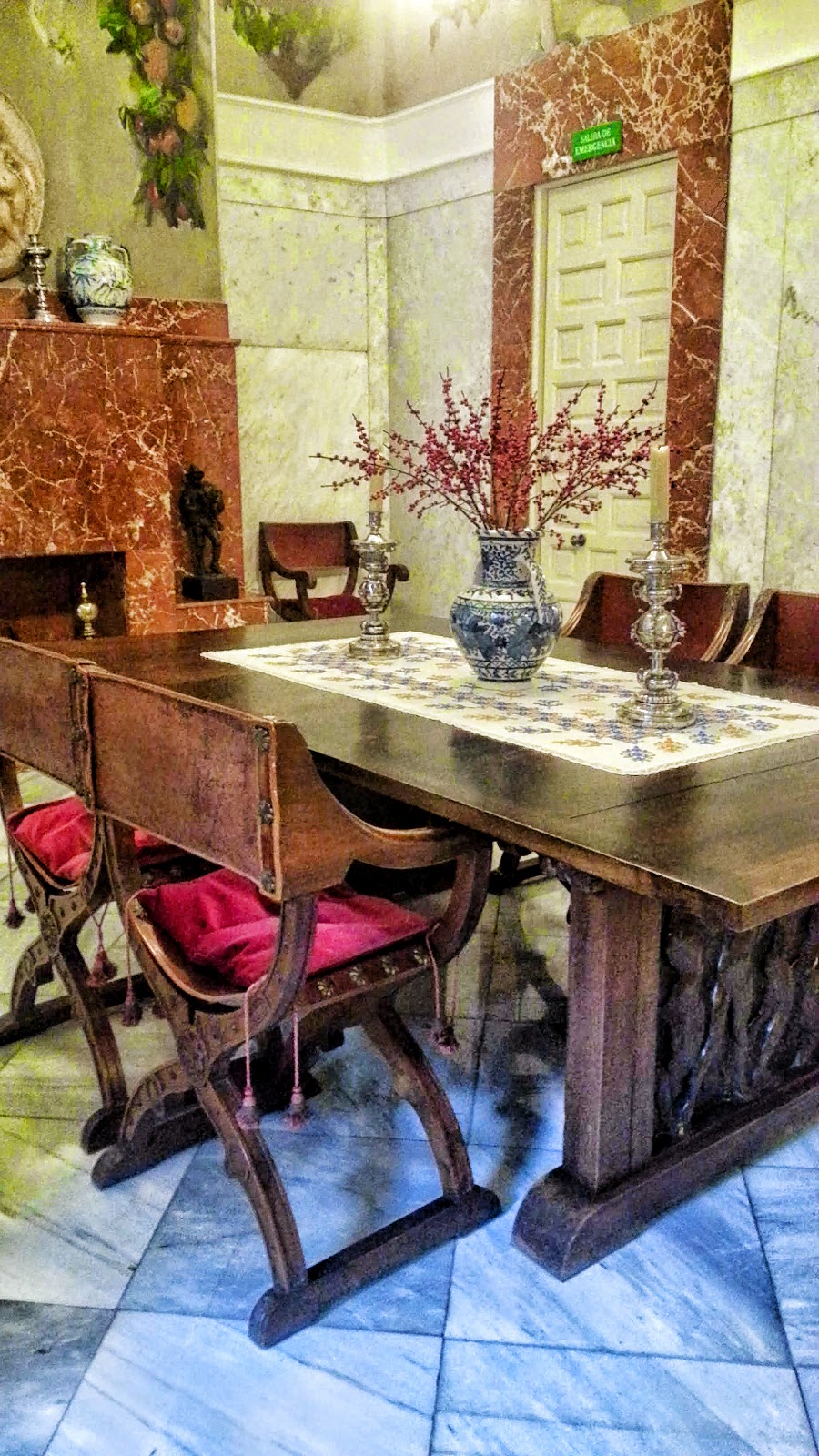
Next, we passed through a small, rectangular room of "azulejo" tiles modeled after King Philip II’s beloved Escorial into the dining room. it was the darkest of the rooms we had seen, with a mural of leafy vines and fruit held up by women dancing across the walls. A fireplace of marble sat at the end of the room, and to its right a window of green circular glass lit a sculptured scene near the above it. In a hall branching off of the dining room, likely into the Kitchen itself, hung a largely unnecessary number of Holy Water Fonts, and circling back near the entrance way of this room we found a painting of the room itself.

Our final stop was the temporary exhibit called Trazos en la Arena, located in the series of rooms at the top of the creaky wooden staircase. Naked children dancing in the sand and brilliant sailboats were brought to life before me in his work. The glare of the sun seemed to leap out of each scene, and my eyes instinctively squinted to prevent them from watering. The cool, flowing water made me thirsty in the warm dry rooms. I wanted to be one of the liberated and seemingly carefree children on the warm beach sands, and I wanted to know what the boy “making eyes” at the bashful woman was saying to her as her feet became tangled in the fish nets. 


I came to Sorolla expecting to be pleased, and I left converted. Having once marveled at the perfection and details of the Renaissance Paintings within the Prado, Sorolla taught me in a couple of short hours how reality is sometimes best depicted through imperfections, minimalism, and light. Instead of showing the viewer an individual’s expressions through exact replicas of their face and body - something he clearly was capable of - Sorolla let on-looker’s feel his character’s whole story, and often without much effort towards making a face. I highly recommend visiting this small home of brilliant work. If you are never lucky enough to visit Madrid, “no pasa nada.” This talented man’s work is endemic, and you just need to take the worthwhile effort to seek it out. But be warned; it may raise your standards, to finding imperfections in exactness of art.