Translate

January 24, 2015

Exploring a Castle, or Two


Our "Christmas Tree" Improvisation
I have to admit, my time here in Madrid has been more difficult than I expected it to be. I miss my home, my bed, my friends, my food. The holidays, naturally made that a little harder, despite the amazing kindness of a coworker and friend who invited my husband and I to a spectacularly fun and welcoming Christmas Eve feast with his family, and our incredibly generous landlords who shared with us their delicious Christmas and New Years Day Lunches. The food and the company lifted my spirits, and our family even Skyped us during the traditional Harvath present time, so we could share in their joy, say hello to everyone, and celebrate as if we were there the whole time – even if we were skipped in the present distribution rotation! And through it all, the isolation made me acutely aware of how wonderful my husband is as he tried everything imaginable to make my favorite holiday magical for us.

An array of dried fruits at
Plaza de Opera Christmas Market
Most of this all made for a good Holiday, though parts of it made me miss home more than ever. Christmas is not as enthusiastically celebrated here (they celebrate an equivalent on January 6th - Los Reyes Magos - but still, not to the extent we do), so the houses were not dressed in beautiful lights, and the closest resemblance to home-decorations were Santas dangling from ropes (or ladders, if you will) out of windows. Here, he does not magically descend down chimneys as he would in the United States, and while the Spaniards may be more practical about their storytelling, the end result is a little depressing. Madrid has developed Christmas Markets over the years that flood the many plazas with stands and people. But apart from the delicious foods, these only dampened our Christmas spirit more. While the Artisan Market in Plaza de España was worth the visit (Jonny and I even ran into each other there trying to buy Christmas presents), the stalls were sullied with mass-produced, cheap   products, and once you saw one market you saw them all.

Plaza Mayor's Historic Christmas
Market - Endless Streams
of Hoards of People.
Adding insult to injury, Madrid is hard-pressed to inspire me in general these days. I have been here so many times now, that its adventurous appeal has begun to wane on me. I needed something new to reignite my passion for travel and exploration. Escorial, while lovely in its own right, failed in this regard. I felt like I had seen it before. I wanted something different, something more inspiring.

And who would have thought such a place existed less than an hour ride away from the city center? Months of research leading up to the move, and every forum I perused discussing Madrid day-trips, failed me. For none of them pointed me to the one place that has finally gotten me excited about being here – Manzanares el Real.

To lift our jaded Christmas spirits, we had decided to find the closest castle, wherever it was, and explore what it had to offer. A search of castles close to Madrid revealed a structure commissioned in 1475. One picture, and we were on board. The internet was barren of information about what we should expect when we arrived, and it was adequate at best when it came to instructions for public transportation. This enrages me in retrospect. The ride was easy, one that fits all budgets, and above all else, leads to a magical place. In a country that depends so heavily on its tourism as a source of income, you would think they would try a little harder. But perhaps, that is part of this particular location’s appeal. The explorers find it eventually, but it is not perpetually inundated with shallow-minded, lazy, tourists, allowing it to possess that more authentic feel.

As I noted, this trip is incredibly accessible from Madrid, and well worth the nauseatingly erratic bus drive. All one has to do is take the metro to Plaza de Castellana via lines 1, 9, or 10 , and ride bus number 724, an “interubana” bus, for €4.20 one way (€8.40 round trip) down a winding and beautifully scenic road towards the gorgeous mountains. When we arrived at Plaza de Castellana, we were slightly confused as to where we needed to board the bus. Unlike the Cercanias, where signs at least vaguely pointed you to the platform you wanted to wait at, here, we were in a large, multi-level bus complex. After crossing off the possibility that it was an above-ground bus stop, we returned to the bus station and actually looked at a complicated, detailed map inside. There, we finally determined we needed to wait at platform (Dársena) 26 on “Island” (Isla) 2, on level (nivel) -3 for bus 724. While waiting, we did notice that there were two stops in Manzanares, but because no one else seemed to mention this confusion in the sparse writings we found, we decided not to worry about it. We would disembark when we saw a castle.

That plan worked perfectly. After telling our bus driver we wanted to stop at Manzanares and paying our fare, we sat back and enjoyed the view for forty minutes, letting the excitement build. Jonny would likely not use the words “enjoy” or “excitement” through a majority of this ride – he is unfortunately rather susceptible to bus-sickness, what with the high center of gravity, unforgiving stale air, and toxic bus fumes, and this is a rough route to have such issues on. Regardless, he survived, and even in his sickened state, he appreciated the amazing views as well.


As we drew closer to our destination, the mountains I spend each morning ogling at from a distance on my way to work came into view and grew larger and more impressively beautiful with each kilometer until it was impossible to see their entirety through the bus windows. I swiveled my head fiercely on each turn, hoping to permanently burn their spectacular wonder into my mind.


In Wisconsin, we have rolling hills, but we don’t have mountains. The first time I saw the Appalachian Mountains, I was equally as awestruck as I was on this tilt-a-whirl bus ride. My dad was amused by my naïve delight, saying I had not seen mountains until I saw the Rockies. And so I went and saw the Rockies, and he was correct. I do not think these Madrid mountains - the Sierra de Guadarrama - were as large, but they take the cake in their unique design. To me, these mountains looked as if they were nothing but large piles of smooth, sandy colored granite boulders that had been stacked by giants in a haphazard fashion. A few would shoot up out of the ground in a jagged fashion, but most looked as if they had been meticulously polished, threatening to roll down into the fields below before smashing into a million tiny boulders like those that had imprinted themselves on the ground below them.

Eventually the Rio Manzanares revealed itself on our left, reflecting the glare of cloudless sky on this warm January afternoon and reminding me of my favorite summer trip to the Lake with my family. It was mere moments before the castle we had come all this way to see, and the quaint little town it hid itself within, appeared before us on the right.

The bus left us at the bottom of the hill leading to the castle and the town of Manzanares el Real itself. It was mid-afternoon and in usual Spanish/European fashion, the outside plazas were filled with people chatting away as they feasted on their lunches. On the tower of the church directly in front of us, storks (at least I think they were storks) had constructed giant nests, and their clacking sound filled our ears as they soared through the air.

The birds in their giant nests, settling in for the night. 
Though small, The Castle of the Mendoza looked just as you would expect a castle to. It  had a square layout, with a tower on each corner, inside and out. We determined we would not buy the tickets to go in. We were on a budget and the reviews on Trip Advisor indicated that the remodeled interior really wasn't worth it. Perhaps we will return and see for ourselves in the future, but for now we were beyond satisfied with the free exploration to be had. For those that do wish to enter, as of now, the prices are: five euro for regular admission; three euro for ages 3-13 and over 60; free for children under 3 and people with physical disabilities. We bypassed the ticket hut and wandered up a short path of shaded stairs until we were standing face-to-face with this archaic wonder.


Speakers had been installed throughout the exterior, and they played period music, reminding me of the Renaissance Faire back home, and making me feel slightly silly. I warmed to it after a while, unable to be sour with such upbeat tunes in my ears while we admired a building erected just under 600 years ago.

The castle was constructed in 1475, at a time when less than 300 people were living in Madrid. It was commissioned by Diego Hurtado de Mendoza, the 1st Duke of the Infantado to replace the older, simpler castle his father had resided in. It was completed within four years by the 2nd Duke, with the assistance of Juan Guas, the architect for the Catholic Monarchs.

We wandered around the castle, peaking into tiny window slots in an effort to see what we could from the outside its orange, granite bricks until we discovered that we were allowed, without tickets, to pass through the grand entrance of the structure and explore its immediate interior! We savored the beautiful view of the entrance – a large brick pathway with turrets encapsulating a gigantic doorway and an extraordinary view of the charming town surrounding it – and then we continued on.


The inside walkway was interesting enough, allowing you to surround the entire building and peak through the keyhole-shaped window slots. For how difficult it was to find any information about this destination or its historical significance, we marveled at how intact it was. All but a few windows seemed perfectly preserved, so much so we questioned the whole thing’s authenticity.


After taking our time soaking it all in, we left the castle’s interior and decided, on this very warm January day to have a picnic overlooking the river on a balcony that had been built into the ground next to the castle.

It had truly been a wonderful adventure, a much needed relaxing trip the day before Jonny began his Spring Semester of school. We packed up our picnic, gazed one last time at the castle, and decided we would take a leisurely stroll through the small, semi-touristy town before heading home. There was, after all, not much more to this beautiful place.

But then, indulging my need to read every informational sign available to me, we discovered our journey was far from over. While reading the brief description of this castle on a nearby pillar, we discovered this castle had been commissioned to replace the old castle nearby. Another castle! We wasted no more time and followed the map, giddy as could be about the two-for-one windfall that had just been bestowed upon us.

While it may have been a castle at one point, all that remains of the vaguely referenced structure is its foundation, a cemetery filled with fake flowers and dilapidated graves, and unfortunately a lot of garbage. A sign near the ruins noted there was not a lot of information on when this castle was built, who built it, or who even lived in it. The only record they had was a passing reference that was made during the construction of its replacement, Manzanares 2.0. Overlooking the disrespectful trash strewn through the turret’s foundation and in the cemetery, we were happy to be standing there in a second castle – or what remained of it – contemplating its mysteries while taking it some more wonderful views of the mountains. And still our day was far from over. The best was yet to come.
What remains of the "Old Castle"

The Cemetery adjacent to the ruins of the "Old Castle"


How could this day get any better than a castle and a half? The answer lay in the portion of the “Camino de Santiago” that passes through this area making it possible for us to enjoy the most incredible hike we have gone on to date. The sun was still shining high and bright in the sky, and we were inspired by our most recent discovery to see what we could find even further off the beaten path. We followed a road that turned into a pathway towards the foot of the most beautiful portion of the mountain where green overgrowth speckled portions of its ascent, with the surrounding boulders growing more immense at each turn.


One of my favorite discoveries on this walk was a pasture, adjacent to the mountain’s initial incline. Therein lay a massive granite boulder that looked as if it had rolled down the hill during the giant’s careless construction.On our return passage, the pasture had been filled with dozens of cows, all adorned with a bell abruptly as they kept their heads to the ground feasting on grasses to their heart’s content.


We wandered deeper and higher until at long, beautiful last, the path leveled out onto a large granite plane, making way for La Ermita de Nuestra Senora de la Pena Sacra, a small church constructed in the 16th Century.


The view here was simply amazing, putting our earlier picnicking choice to shame. As we sat, admiring the intoxicating views, we observed the occasional camino-walker stop to silently pray before the building, and the periodic local arrive to sit over the ledge and smoke a cigarette. Three dogs appeared at one point, and I watched them circle the building merrily, playing in the random rain puddles formed within divots of the granite. It was all so incredibly cathartic.


I have been fortunate to live out many unbelievable experiences. I have driven as far east and west as the United States can allow; I have relaxed on the beaches of the Bahamas, Florida, Valencia, and the Canary Islands; I have tended to baby rhinos, giraffe and koala bears; I have performed professionally on stage with tigers and magicians; I have explored several enigmatic complexes of kings and queens. Each realization has, in turn, opened my eyes to the possibility of more discoveries and adventures that lie in wait for me, hoping to become known. I have loved each one in turn, all of them showing me what it means to feel alive and proud of my accomplishments. But this unplanned discovery has been the most purifying, majestic journey of my life to date. We almost overlooked this opportunity due to the dismal advertising of its wonders. Maybe it is best to keep it away from the prying eyes of superficial tourists. But if you want to see how beautiful this region can be, how contentedly happy you can feel simply surrounding yourself in natural wonders, then go, go, go to Manzanares. You absolutely will not regret it.


It is safe to say leaving here brought with it a heavy sadness. Returning to the harsh chaos of the big city and facing the next, long day of work for myself and school for Jonny ran the risk of erasing this high we had been floating on for hours. The sun was setting, and we had no choice but to return. However as we boarded the bus for our journey back, the evening glow lit up the castle that had pulled us to this town in the first place, and I wondered what would come next to rival this joyous adventure.


January 20, 2015

Finding my home in far off places


My experiences with long-term moves have taught me that you cannot truly feel as though you have arrived somewhere, until you leave for a little while. In other words, you need to go on an adventure! When I studied abroad in Toledo, I was not enamored with the experience until I spent a weekend in Valencia. When I moved to St. Louis for law school, I needed to drink in the breathtaking landscapes of Missouri wine country in the fall to feel like a true resident. This time, to become acquainted with my new city, I traveled to the outskirts of Madrid to visit a centuries’ old palace-turned-monastery-turned-UNESCO world heritage site: El Escorial.


“El Monasterio de San Lorenzo de El Escorial” can only be described as an elaborate labyrinth composed of a monstrously tall Basilica, a quaint 16th Century royal palace, a morbidly ornate and beautiful mausoleum, and a library fit for Bell in “Beauty and the Beast.” El Escorial was constructed between 1563 and 1584, by Spanish Architects, Juan Bautista de Toledo and Juan de Herrera, under the guidance of King Philip II of Spain, and it functioned as the residence of the Spanish royal family for several years. Madrid had recently become the capital of Spain, and Philip’s father, Charles V had left a codicil in his will desiring such a place be built for him and his late wife Isabella of Portugal to have a final resting place. Escorial was deemed the perfect place as it was near enough to the new capital to hold court. And so, taking the money obtained through the conquests of the Americas, and spending more than they could ever generate, Escorial was commissioned.
 
Described to me as one of the most Catholic places in the country, El Escorial is a manifestation of King Philip’s hard-fought battle against the Protestant Reformation, and Spain’s commitment to becoming the center of the Christian World. King Philip devoted most of his reign to this anti-Protestantism effort, as well as most of the wealth Spain had acquired from the New World. El Escorial was meant to serve as both a retreat and home of the royal family as well as a place for scholars of Catholicism. Today, El Escorial’s Mausoleum serves as the burial site for most of the Spanish Kings from the last 5 Centuries, housing both the Bourbons and the Habsburgs. Tombs in the Royal Mausoleum include Charles V of the Holy Roman Empire (King Charles I of Spain), King Philip II, King Philip III, King Philip IV, King Charles II, King Louis I, King Charles III, King Charles IV, King Ferdinand VII, Queen Isabella II, King Alfonso XII, and King Alfonso XIII. The entire complex is now an UNESCO World Heritage Site that is witnessed by over 500,000 visitors annually.
 
El Escorial is the perfect day trip for Madrid visitors or residents. Only 28 miles northwest of the Madrid Capital, at the foot of Mount Abantos in the Sierra de Guadarrama, it is simply a ride from a cercancias metro station, lasting approximately one hour, and it cost €4.00 each way (€8.00 total per person).  We arrived via metro to the nearest cercancias station to where we are staying - Chamartín (there is also Atocha, Nuevos Ministerios, and Recoletos), and from there we took cercancias line 8. There was a bit of confusion because, in true Spanish form, not all of the signs are clear if you do not know what you are doing, even for a relatively fluent Spanish speaker. While every sign indicated we needed to take the cercancia line 8, nothing was said about which platform this line arrived at, and unlike the main metro lines, multiple lines passed through on one platform. I believe it ended up being platform 6 we needed to wait at. There will be a sign with a list of locations and the platform you need - so look for El Escorial in the list, and simply go to that platform. The trains arrive hourly, which is frequent enough if you pay better attention than we did. Through confusion as to whether we needed to be on cercancias 6 or platform 6, we just missed a train and found ourselves waiting an hour until the next one.“No pasa nada.”
 
Most of the journey on the cercancias is above ground, and if you are lucky enough to travel on a clear day, you can witness beautiful Spanish landscapes. Heading into the mountains, we passed several large farms, some with strange deer-like animals I have never seen before (they looked like muntjack deer with gigantic antlers, and there were hundreds of them!), others with horses, and, some of course, the iconic black bulls.
 
 
Once you arrive at the end of the cercancias line and exit the metro station, you will find a bus that, for an additional (€1.60) will carry you to the top of the hilly landscape, near to El Escorial. We were not sure what this “hill” alternative would be like to climb, so we took the bus as most recommend. It was more akin to a greyhound bus than the city buses we had seen in Madrid, parked outside the metro, unlabeled, with no bus stop or station signs near it. We were initially hesitant that this was the right way, but we watched several tourists hop on, and we asked a random individual in broken Spanish if this was the way to El Escorial. His smiling affirmation was enough for us, and we joined the other bus riders. The hill would have been a minor inconvenience to walk up - it was slightly steep, and we may not have known the exact way there without the driver leading the way - but it looked by no means insurmountable. In just minutes we were at the top of the hill getting our first glances at the beautiful structure.


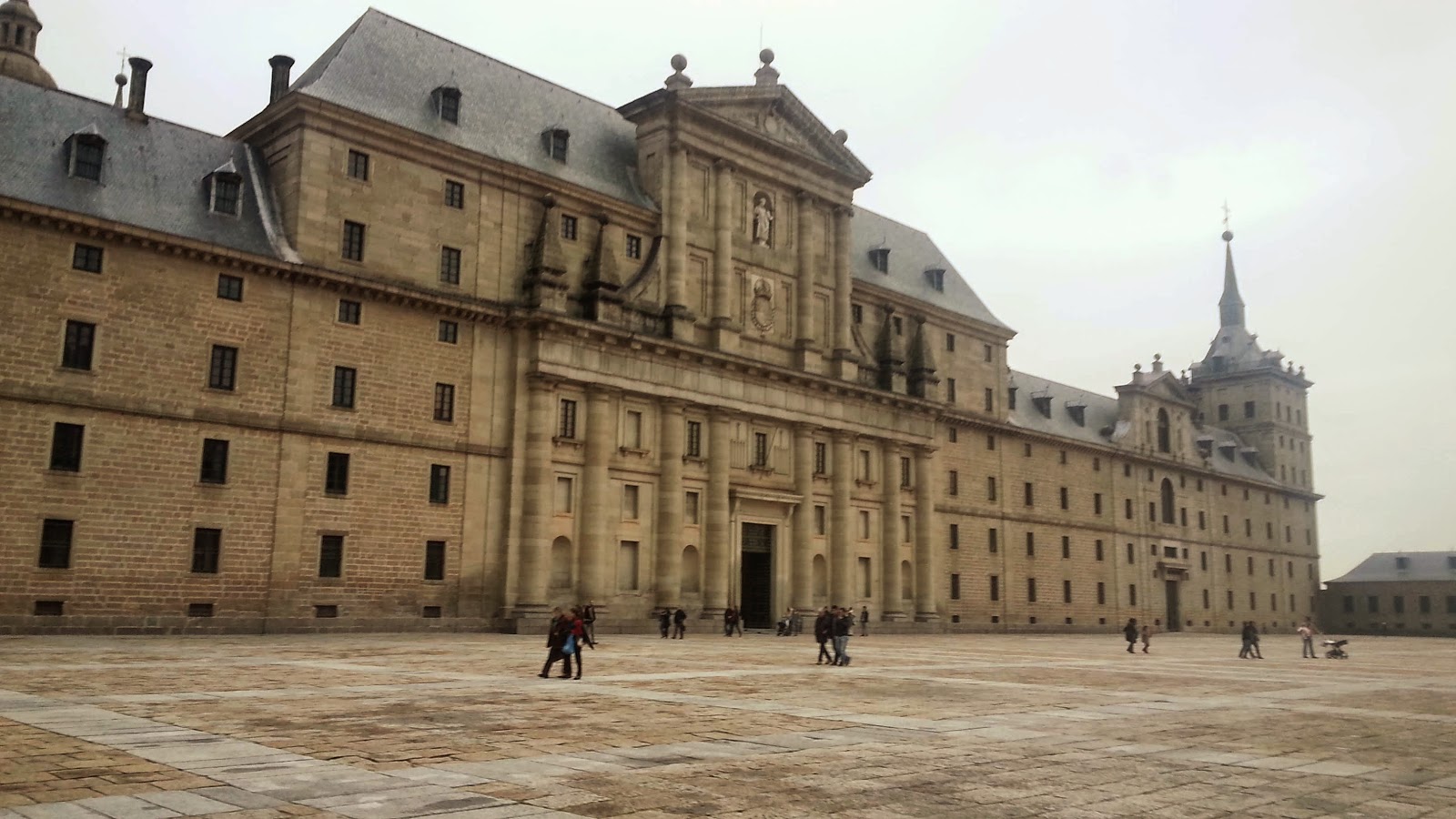
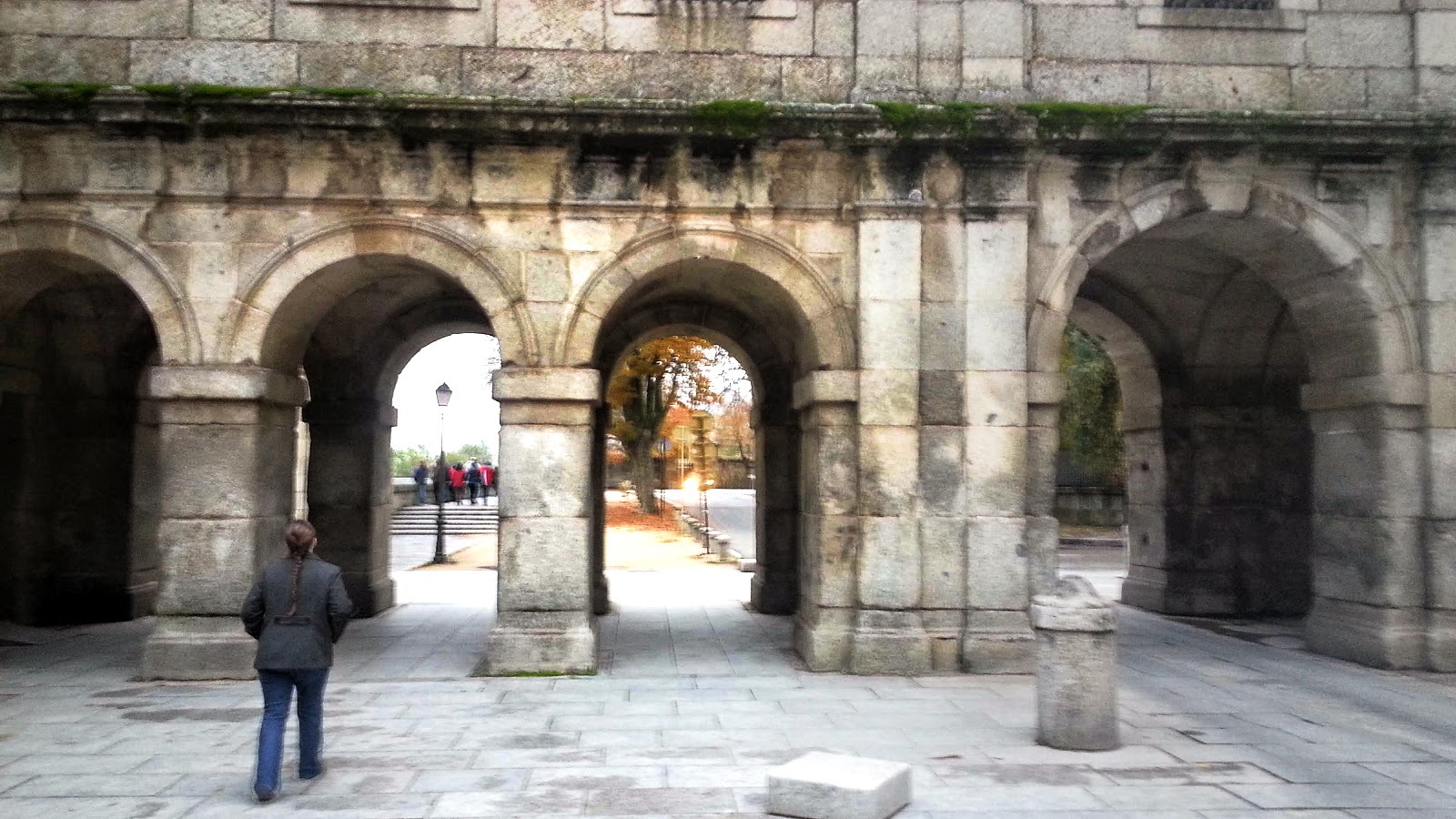
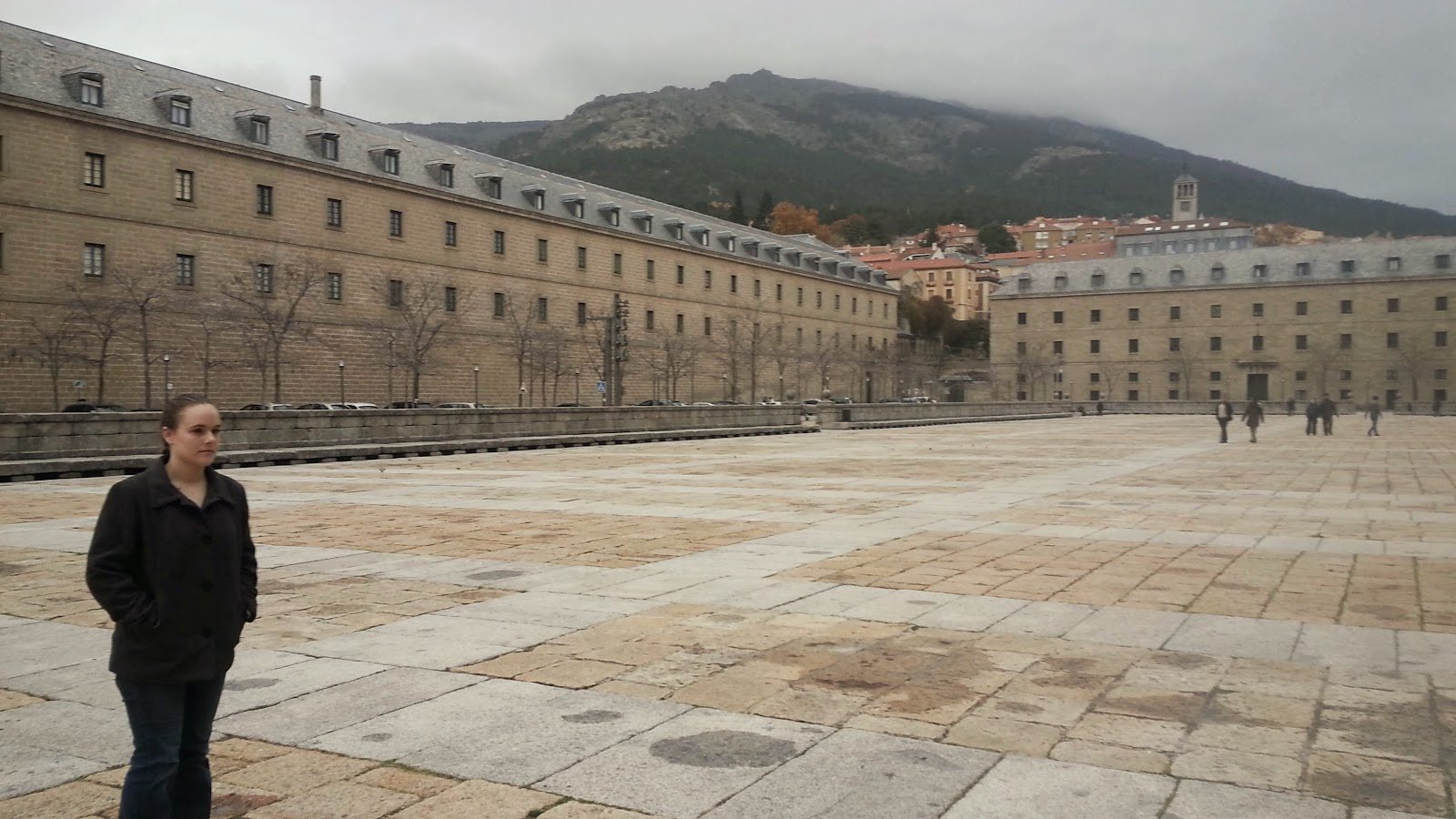
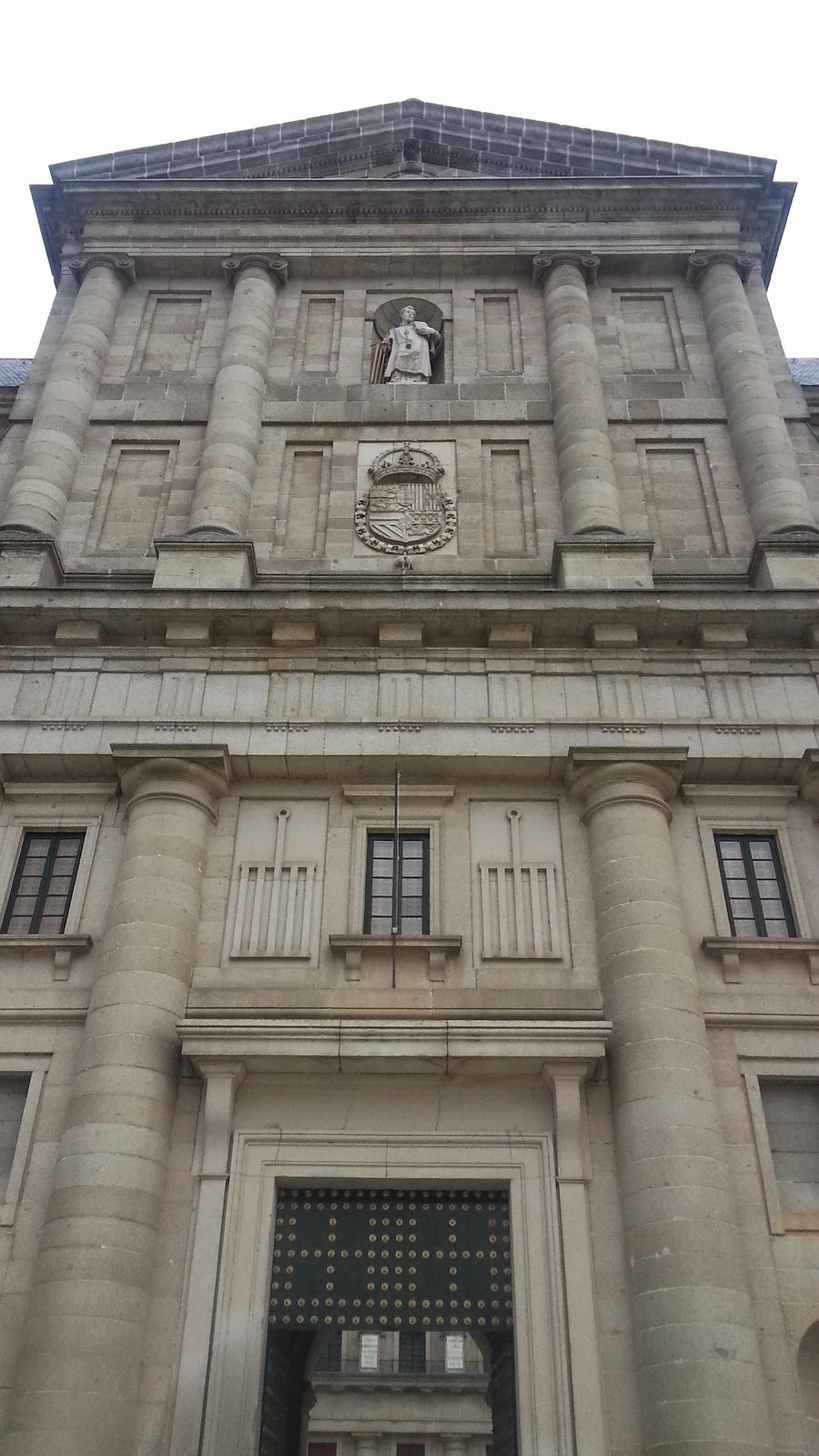
We departed from the bus and took a five minute walk to the main entrance, taking in the colorful fall leaves and the large dome of the basilica peeking over the fortress walls. We walked up the most obvious path lined with trees and found ourselves in an immense courtyard whose ground was composed of giant beige bricks. To our left was a tall, long wall lined uniformly with windows, and we followed it around a corner, where we came upon the tourist entrance to the building. It consisted of a sign that said tourist entrance, a couple of Plexiglas doors, and three security guards. After passing through a metal detector and having our bags scanned, we were ushered into a second, smaller hall to purchase our tickets. Frustratingly, there was no sign to be found regarding the price of admission anywhere in this room, nor on the websites we perused while we waited for our turn. Only upon leaving through the same doors we had entered in did we notice a fancy sign in small print high up on the wall where we passed through security. Regardless, we were successful in asking for two tickets, €10 each though we failed in determining if there were any student discounts. (Let me know if you know in the comments please!) We also neglected to purchase an-audio guided tour, as reviews on trip advisor warned against wasting the money. Tickets in hand, we began to explore.

Our self-guided tour within the complex began in a cold, echoing hallway filled with arched passageways and concrete walls. We wandered aimlessly for about one hundred feet before Jonny was told he would have to put his backpack in a locker for the remainder of our tour (and no photos either - Que Lastima). After our brief detour to the locker room, we passed through a narrow stairway that opened up into an architecture museum. Jonny found this section far more fascinating than I did, me having no ability to remotely comprehend a blueprint, let alone one from 16th Century Spain. Apart from the blueprints I gave little credence to, there were several models to examine as well as displays of the actual tools and items (maybe mere re-creations?) used to construct the building. These included not only 16th Century pulley systems for moving the large stone bricks, but also hand-crafted nails of varying sizes, and even glass windows through which it would be impossible to see an image distinctly - all more interesting for the average person, unable to appreciate the technical marvels of architectural design. This section of our tour ended with a limited display of cooking tools and dishes, from three-foot long rusted serving spoons to porcelain crocks decorated in the traditional blue and white designs. I was ready to move on!
We wandered indiscriminately until we came upon the start of a quasi-art museum. There were beautiful and dark paintings lining every wall as if we had stumbled into the Prado. I wish it had become more commonplace to have commissioned artwork so large our ceilings needed to be higher, as these works would have required. They were all, unsurprisingly, depictions of the Holy Family and or popular Biblical tales. We were amused by the images of cherubs looking down over Mary - consisting only of heads and wings, perhaps attempting, though in vain, to provide the illusion they were flying around horizontally. Conversely we were also impressed and felt a sense of foreboding in images that seemed beyond their time in technique. Scenes in the forefront would be clear and vibrant with shadows or faded images of past events looming in the background, allowing the viewer to see a whole story, all at once, almost as if it were an optical illusion with the scene playing out before us. We passed from room to room, finding more and more paintings on the whitewashed walls, for what seemed like hours. Occasionally, we were led down hallways with floor-to-ceiling, narrow windows overlooking a manicured garden, and we would pass through doors that all the unfortunate modern individuals of a more average height needed to hunch through. It was during these times I would feel a rush of excitement at the reminder that I was in a 16th Century Palace. Wrong country of course, but I could not help but feel like I had been drawn into a scene from “The Tudors” walking down these passageways.
From there, we entered into what was the living quarters of King Philip II and his family. The rooms were more plain than I had expected - whitewashed walls with a blue and white patterned tile Spain seems to absolutely love - but artifacts of the time had been arranged in each one to keep us tourists interested. We saw Philip II’s bedchamber where his bed was arranged to look out over the mountains during his episodes of gout , the guards’ room, and the welcoming hall,  but my favorite room here was a long, open hall lined with windows overlooking the hilly, tree-filled landscape below the foot of the mountain. This was where Philip would walk with his children in the evenings, taking in beautiful sunsets. The doors to hall were the most remarkable component of the room. They were truly masterpieces, each in their own right. They were wooden (and of course too short by modern standards), but very thick, and very elaborate. Different shades and cuts of wood had been pieced together to create various beautiful scenes on the smooth surface of each door - flowers, columns in plazas, and birds danced across the spectacular finish. I have never seen anything like it before, and I may return someday just to commission doors of my own or at least retake the picture I was only able to capture in my mind.
Finally, after wandering through the palace, we followed a couple flights of marble stairs down into the Mausoleum (The Royal Pantheon). Several signs ask guests to be particularly quiet through this part of the tour, but I do not know who would be able to even find words upon first witnessing this breathtaking sight. It was beautiful. In this round room, the ground consisted of an elaborate design composed of dark grey and pink marble, and above us hung an intricate, gilded chandelier. Straight in front of us was a beautiful alter. And we were surrounded by caskets set high into the walls and marked with their inhabitant’s names. While I understand the sentiment fully, and while I would never wish to disrespect those laid to rest in this beautiful crypt, I was, for a moment, enraged at the prohibition of photography. Words could never describe how beautiful this room was, and mine fail to capture the intricacies of it all. Of course photos would never do it justice either. But instead of lingering on this, I simply stood and took it all in for myself, as you all should do as well if ever given the chance. Close your mouth, put down the camera, and take it in as you reflect on your brief existence surrounded by these amazing opportunities.
From there, we climbed back up the stairs, and then down another set to continue our journey through a very long crypt. The caskets were often white marble, covered in very elaborate carvings and detail. Above notable caskets hung the family crest, and signs were displayed in English and Spanish to inform you who had been laid to rest there. Each room contained approximately 12 caskets. On top of one very large casket set apart from the rest with its own alter was a grey marble depiction of the individual within, and one room was dedicated to a large, circular structure housing multiple caskets of younger individuals. Throughout, I was partly awestruck, partly creeped out. Indeed, significantly more contemplation had been directed towards the dead than the living in this complex.


After making our way through the mausoleum, we passed through a few more halls, each more elaborate than the ones preceding it. Here, the halls were lined with wooden benches (complete with signs begging visitors not to sit - these are 16th Century chairs after all) and the ceilings were covered in murals, again with very religious connotation. These halls led to a tall, exterior hallway, decorated with bright-colored paintings, heavenly scenes on one side, and shuttered windows overlooking a courtyard on the other. Upon reaching the end of this passageway, we found ourselves in an impressive courtyard leading to the entrance of the basilica.
Another moment a camera would have been beneficial, yet again insufficient, was within the titanic basilica of El Escorial. I still prefer the Basilica of Toledo over this one, but Escorial’s is beautiful in its own right. At its very center, high up in the ceiling, a beautiful dome peaked into the sky with windows along its perimeter to cast natural light within the dark stone hall. A few halls branched off of the main church where one could find private chapels and altars to pray and give alms. There, statutes of Mary and paintings of the holy family were depicted. At the back of the main church, above the entrance, was a balcony possessing the church organ and its massive pipes, as well as room for a choir. A mural gazed down over the balcony, so vibrant that it looked almost three dimensional at a distance. Finally at the front was an altar so elaborate that I began to recall the one within the mausoleum. This time, there were more gilded statues and paintings casting a reddish-orange hue over the area. At the top of it was the requisite statue of Jesus being crucified, and above that still, another vibrant mural on the ceiling.
 
When I was in grade school, I remember hearing, and believing, that my church was one of the best. It was beautifully decorated with a gorgeous altar and many statues along the wall. It also had amazing stain glass windows that told the story of Jesus, and two additional altars to the left and right of the main one, always covered in flowers and with a copy of the painting, The Black Madonna. Both of these altars had statues in white stone, but I cannot remember the image clearly enough anymore. I loved my church at St. Adalbert’s, but it could never hold a candle to the ones in Spain. We took one last look at the beautifully foreboding room and marveled at its epic heights. I was only later informed that for several years, in the 16th Century this was the tallest building in the world. I was not surprised. Our footsteps echoed across the grey, stone floor in the open room as we departed the Basilica for our final stop within El Escorial – the library!
After taking in the dark, cold wonders of the Basilica, Jonny and I crossed the courtyard and to our right we found a staircase leading to the library. We traversed several flights of stairs, encountering more short doors on each landing, and hesitating over the deterioration of some of the steps. But after the long climb, we made it, safe and sound. I am in love with beautiful libraries, and the one at El Escorial did not disappoint. We entered a long room with an arched ceiling covered, once again, in a beautiful mural. Along each of the walls shelves were filled to the brim with beautiful and old looking books, and some of the bookshelves had certain books open for guests to view the gold leaf lettering and artwork. In the center of the room, several globes, ancient and inaccurate, lined the path. At the end of this line of globes was a structure resembling what people of the time thought the universe looked like within an Armillary Sphere. Metal wires twisted around the outside, and the Earth, in all of its apparent glory, rested at the center. The library was beautiful, and I would have loved to stay, perhaps forever, to read the books that likely have not been breathed on, let alone touched, for decades, and to do so in such a beautiful and old room. But alas, they were in Spanish, and it was time to leave the building.


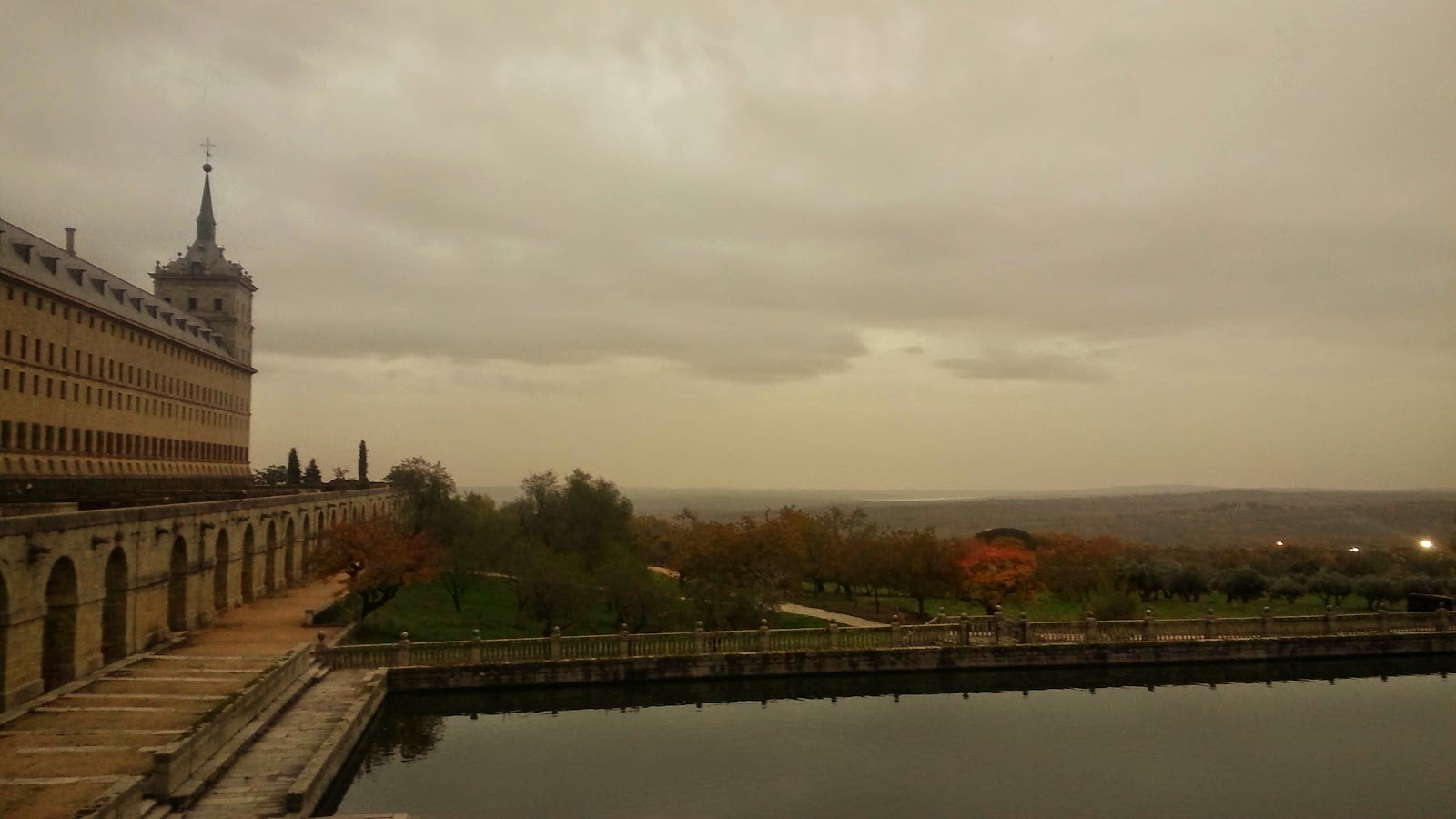
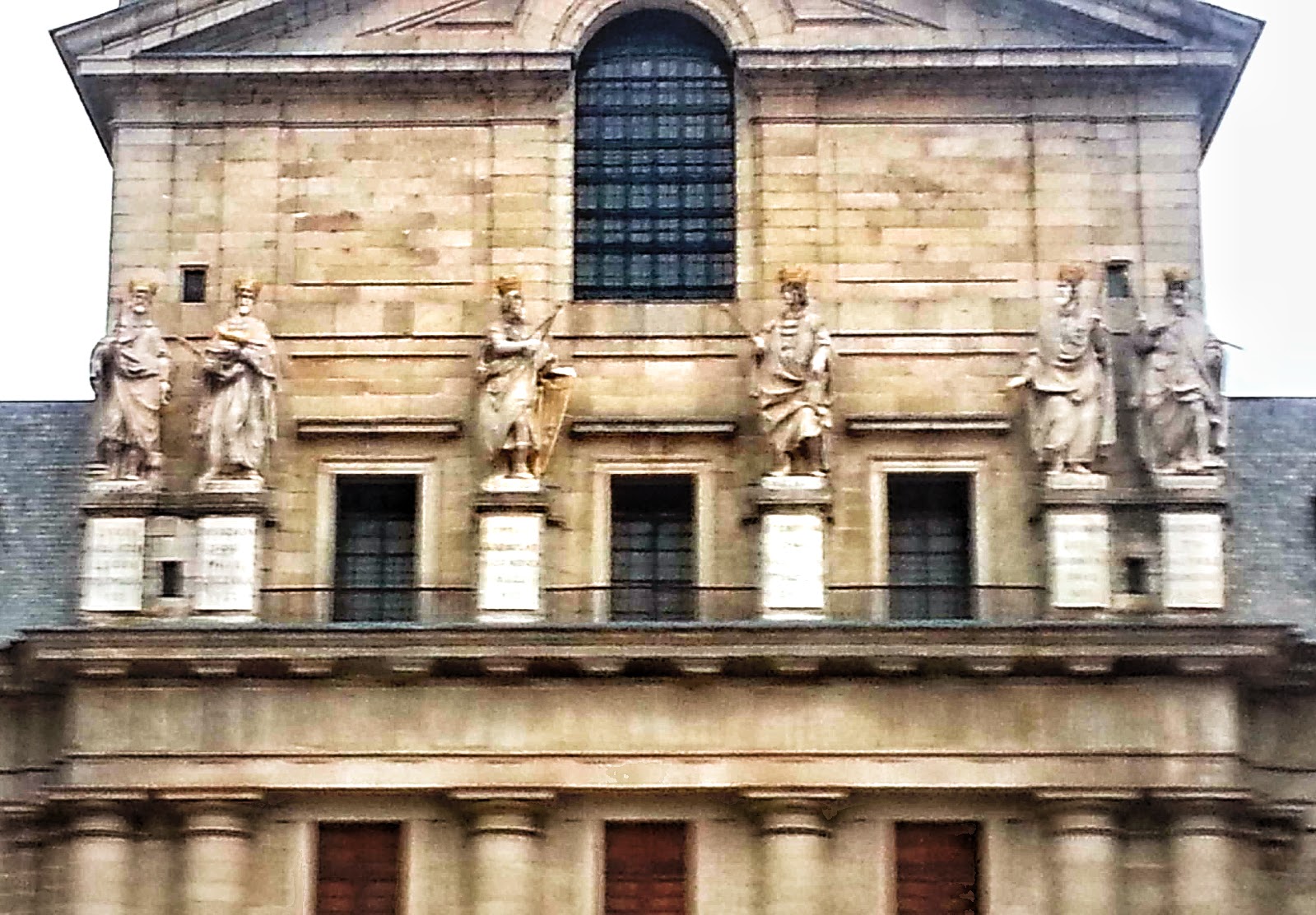
Before departing, we lingered outside and took in the massiveness of the complex and its surrounding environment. Had we planned better, we may have taken a trip to the Valley of the Fallen, which many recommend doing after coming all this way. Instead, we spent some time wandering, looking at the mountains concealed in a cape of fog, and discovering some beautiful, unmarked statues in the small park across from Escorial. After some final, longing glances at the walls that hold many ancient secrets, we turned and headed down the hill to the bus stop, to begin our hour-long journey back to the city, back to our home.