
I vividly remember learning about aqueducts in my grade school history classes with Mr. Loehr and wondering, “why on Earth are we talking about this?!” Running water seemed to be a nice addition to what I had naively imagined to be primitive living, an advantage I have taken for granted, having always had it myself. While I thought it was nice for the Romans to have water and all, I did not understand why we were going on and on about some gutters in the ground. Fortunately, I have wisened up in my older years, and I am jumping on the bandwagon - aqueducts are not only ingenious architectural creations, they are monstrous works of skillful art and something everyone must see and experience for themselves.

Segovia, Spain is one of the best - and for that reason one of the most popular - day-trip options from Madrid. Beyond its over 2000 year-old aqueduct, it has a fairy tale-esque castle you can storm (by climbing 152 steps), famed roast suckling pig to devour at every restaurant, and, of course, a beautiful Gothic cathedral. You can engage in each of these delights in one full day, and from Madrid, the trip is a 28 minute bullet train ride (and a 15 minute bus ride).
Segovia (Victorious City) originated as a Celtic landholding, with control then passing to the Romans to be used as a Latin convent. It was then abandoned centuries later, following the Islamic invasion of Spain. Around 1080 the city was resettled with Christians from north of the Iberian Peninsula and beyond the Pyrenees. In the Middle Ages, given the city’s key position on trading routes, its industry of wool and textiles exploded and continued throughout the 16th century. Jewish populations began to settle in the region, and its collective population rose to 27,000 in 1594. However, this prosperity was short-lived: one century later the population fell to 8,000. Attempts to revitalize the textile industry in the 18th century were unsuccessful. In 1764 Spain’s first military academy, the Royal School of Artillery, was opened, and in 1808 the town’s forces were put to the test as French troops sacked the city during the War of Independence. Less than 30 years later, it was unsuccessfully attacked by Don Carlos in the First Carlist War – a Civil War over succession to the throne in Spain. Segovia finally saw its population recover in the 19th and 20th century, having achieved relative economic stability.
Segovia (Victorious City) originated as a Celtic landholding, with control then passing to the Romans to be used as a Latin convent. It was then abandoned centuries later, following the Islamic invasion of Spain. Around 1080 the city was resettled with Christians from north of the Iberian Peninsula and beyond the Pyrenees. In the Middle Ages, given the city’s key position on trading routes, its industry of wool and textiles exploded and continued throughout the 16th century. Jewish populations began to settle in the region, and its collective population rose to 27,000 in 1594. However, this prosperity was short-lived: one century later the population fell to 8,000. Attempts to revitalize the textile industry in the 18th century were unsuccessful. In 1764 Spain’s first military academy, the Royal School of Artillery, was opened, and in 1808 the town’s forces were put to the test as French troops sacked the city during the War of Independence. Less than 30 years later, it was unsuccessfully attacked by Don Carlos in the First Carlist War – a Civil War over succession to the throne in Spain. Segovia finally saw its population recover in the 19th and 20th century, having achieved relative economic stability.

Segovia finally reaped the benefits of its historical foundations when, in 1984 both the city itself and the aqueduct specifically were declared World Heritage Sites by UNESCO. With its narrow cobble-stoned streets, Jewish architecture, and astounding landmarks, the humble city is truly a walk back in time.
Often, when arriving in different towns, I have found there is always one more step I need to take to get where I really want to go. To get to Paris and Rome we needed to take an hour-long taxi. In the Canary Islands, we ended up needing two busses, a long walk, and a Ferry Ride. Our honeymoon in Malaga was a nightmare of trains, buses, and taxis. While it takes a train and a bus to get to Segovia, it was all very easy, very cheap, very fast, and it all allowed for a few beautiful views of the surrounding area. After arriving in nowhere-Segovia’s train station, we disembarked, stepped outside and found two buses waiting to take us to our destination. You step off the bus, look to your right, and feel faint at the monstrosity before you.
The Aqueduct of Segovia is shrouded in mystery and wonderment as to when exactly it was built and how it has managed to stay so well preserved throughout Spain’s history. The Aqueduct used to have an inscription of its date - but that has long-since vanished. Most assume it was built in the 1st Century.

The fascination surrounding this creation does not stop upon first witnessing its grandiose size. It only grows when you realize this is an ingenious work of architecture. This behemoth has managed to withstand centuries of mother nature, human recklessness and general aging - with no mortar. The stones in the Segovia Aqueduct are holding themselves up.

We explored the sight briefly that morning before heading off to our next destination, and we returned in the evening to have a drink and continue to marvel at it all, holding my breath and pondering what a terrible catastrophe it would be for this seemingly fragile world-wonder to collapse before us.


Our next visit was a brief tour of the Cathedral of Segovia. The Cathedral is located in Plaza Mayor, dedicated to Virgin Mary. It was one of the last Gothic Cathedrals constructed in Spain and Europe as a whole, between 1525 and 1577. A former Cathedral had been built adjacent to the Alcázar, but it was destroyed in a siege while attempting to protect the Alcázar. To avoid future chances of similar destruction, the Cathedral is now a good distance away from the palace.


In sharp contrast to the vulnerable appearance of the giant roman plumbing system was the Segovian Alcázar, perched high-up on a rocky peninsular hill that juts out of a fork in a stream. Many liken its position and structure to that of a ship, and when you climb to the top of the tower, it does feel like you are in fact steering the palace forward through raging … hills. It began as a fortress, served as a royal palace, was used as a prison, transformed into the Royal Artillery College, and now, it calls to visitors far and wide as a museum.

The Aqueduct of Segovia is shrouded in mystery and wonderment as to when exactly it was built and how it has managed to stay so well preserved throughout Spain’s history. The Aqueduct used to have an inscription of its date - but that has long-since vanished. Most assume it was built in the 1st Century.
The fascination surrounding this creation does not stop upon first witnessing its grandiose size. It only grows when you realize this is an ingenious work of architecture. This behemoth has managed to withstand centuries of mother nature, human recklessness and general aging - with no mortar. The stones in the Segovia Aqueduct are holding themselves up.
We explored the sight briefly that morning before heading off to our next destination, and we returned in the evening to have a drink and continue to marvel at it all, holding my breath and pondering what a terrible catastrophe it would be for this seemingly fragile world-wonder to collapse before us.
Our next visit was a brief tour of the Cathedral of Segovia. The Cathedral is located in Plaza Mayor, dedicated to Virgin Mary. It was one of the last Gothic Cathedrals constructed in Spain and Europe as a whole, between 1525 and 1577. A former Cathedral had been built adjacent to the Alcázar, but it was destroyed in a siege while attempting to protect the Alcázar. To avoid future chances of similar destruction, the Cathedral is now a good distance away from the palace.
 |
| A view of the Cathedral from the Alcazar Tower. |
I’ve seen dozens of Cathedrals - most of them Gothic - at this point, and they all have started to run together, with their gilded altars, arched ceilings, multiple chapels, and stained glass. However, each one has evoked a unique character that seem to make them all worth the visit. Entrance to the Cathedral in Segovia was €3.00 each, and sadly, no photos whatsoever were allowed once inside. And so, as with Escorial, I put my phone away and focused on taking it all in. Noticeably, while this Cathedral has been dedicated to the Virgin Mary, its chapels seemed to indicate otherwise; almost all of them focused their art on the story of the crucifixion. It was, honestly, a little too much for me. Unlike other cathedrals I had visited, this one seemed to be more in a state of disrepair - or perhaps a constant state of repair? Water damage was evident here and there, parts of the marble floor had worn away, and some of the altars seemed in dire need of polishing. Along the walls, aligned with the peak of the 33-meter-tall arches so characteristic of Gothic churches, bright stained glass windows told a story, but some were missing. I personally liked the abandoned sentiment of it all. I found solace in the antiquity of the building’s spirit, and I appreciated its genuine nature.
After passing through each chapel, we entered into a courtyard that led to two more rooms. The first was a small museum of silver and gilded chalices and crosses, french tapestries, and interesting paintings. The second was the "Chapter House" covered in Flemish tapestries from the 18th Century and topped with a 17th Century Renaissance-style masquetry ceiling. I think this means gilded and over-the-top embellished. This room reinforced a practice we have developed in our time here - look up!
In sharp contrast to the vulnerable appearance of the giant roman plumbing system was the Segovian Alcázar, perched high-up on a rocky peninsular hill that juts out of a fork in a stream. Many liken its position and structure to that of a ship, and when you climb to the top of the tower, it does feel like you are in fact steering the palace forward through raging … hills. It began as a fortress, served as a royal palace, was used as a prison, transformed into the Royal Artillery College, and now, it calls to visitors far and wide as a museum.
The location has been of military significance for all of its known history, originating as a Roman, and then Arab fort, until the 12th Century when King Alfonso VIII decided to make it his and his wife’s personal residence. The following Century, a large cave-in led to more remodeling of the growing palace, and in the 15th Century, King John II made the largest contributions to its construction, with the accomplishment of the “New Tower” (John II Tower).

After 1570, upon King Philip II’s marriage to his niece, Anna of Austria (his fourth and most beloved wife), he had sharp slate spires added to the Alcázar to reflect the current styles of central Europe. When the royal court took up residence in Madrid, the Acázar was used as a state prison for about 200 years before King Charles III converted into the Royal Artillery School in 1762. After 100 years of existence, a fire badly damaged the building, and restoration did not begin for two decades. During its restoration, its original features were exaggerated and beautified to reflect the 19th Century obsession with fairy tales and magical kingdoms, making the building more ornamental than functional. Thereafter, Alfonso XIII designated the Ministry of War to use it as a military college. It is now one of the most popular historical tourist destinations in Spain.

After taking in the wonderful external views of the Alcázar, rumored to have inspired Walt Disney’s creation of Cinderellas Castle, and gazing across the yellow and green planes below us, we stood in line, bought our tickets, and began our exploration.As far as ticket costs go, the normal entrance fee is €5.00, plus an additional €2.00 to climb the tower (which is foolish to go without). The student discount is €3.00 for the normal entrance (the tower is still an additional €2.00). However, unlike most student discounts provided in Spain, this one (at least for us) did not ask for further confirmation of our ages - meaning we both got discounts!

We passed through the entrance and began our self-guided tour of the fortress in a side Military School Museum. This was interesting as it had miniatures of the many cannons and laboratories used (from my understanding, they made ammunition here), as well as beakers and jars full of materials used for making explosives. After touring the displays, we decided it was time to see the actual building.

The first room you enter in the Alcázar is the Sala del Palacio Viejo (the Old Palace Room). The main feature here was a fascinating array of armor for horses and men alike. I enjoyed the reminder that I would have been tall in the 16th Century, and Jonny was intrigued by the spear-like toes on the feat of many suits. Apart from the museum decór the room was rather bare, and we moved on.


From the Old Palace Room we entered the Sala de la Chimenea (the Fireplace Room) a small room - with a fireplace - encumbered with a large wooden table. There was some interesting furniture, but we continued on quickly.
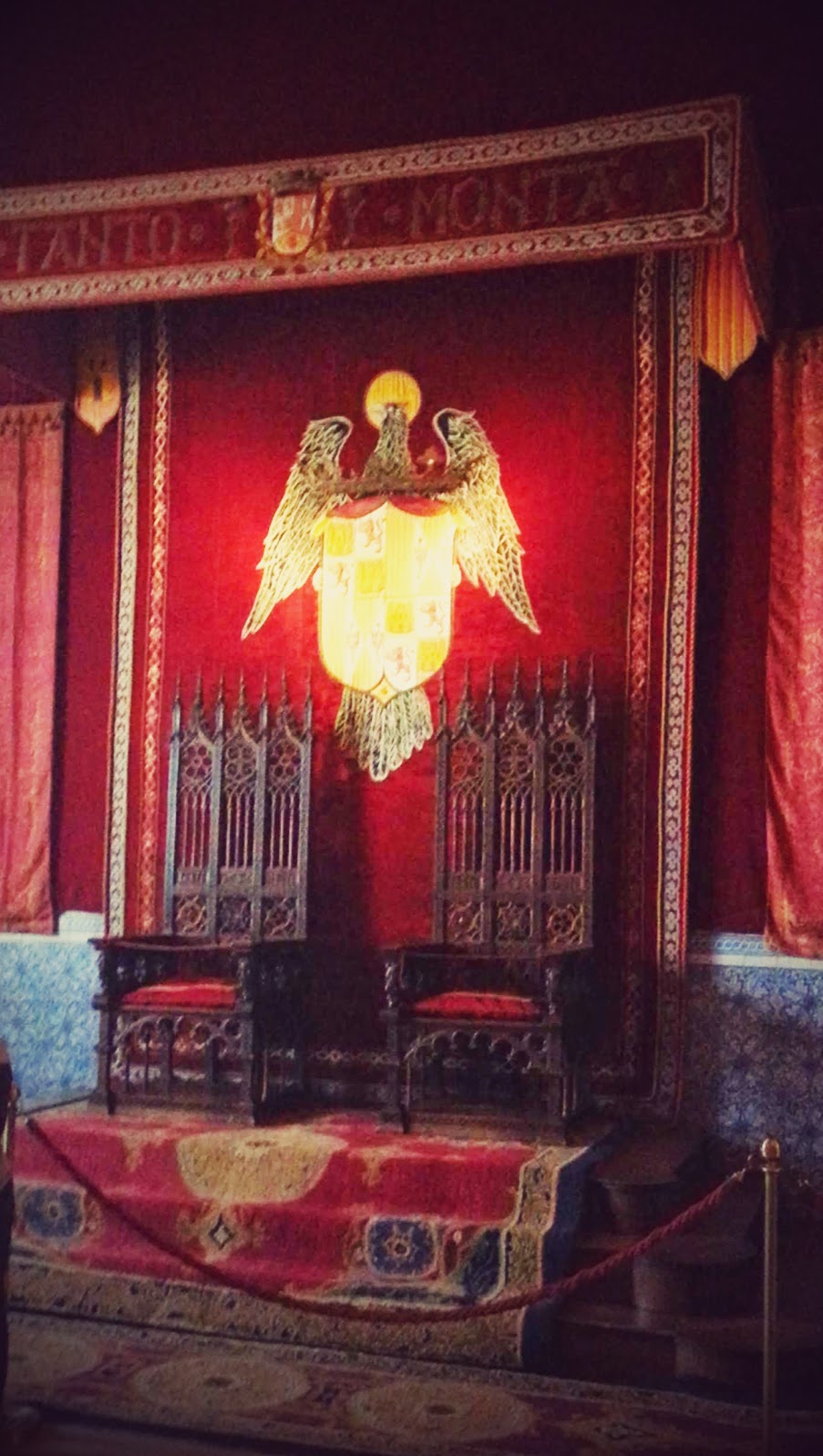 Next came the Sala de Solio (the Throne Room). The extravagant mudejar room itself was constructed in the 14th Century, when the Castilian province was under the controversial rule of the Trastámara Dynasty (upon the death of Alfonso XI of Castile, his illegitimate son, Henry II took the throne from his legitimate son - Peter the Cruel, and that branch of the family ruled Castile, and Aragon, until Ferdinand and Isabella united the country). The top half of the walls were adorned with blood-red cloth, under which blue and white glazed tiles (Azulejos) stretched down to the floor. Intricate gilded doors hung below beautiful archways, and the domed ceiling was a fantastic cornucopia of red and blue detail. The throne itself, added to the room in 1808 in honor of Alfonso XIII and his wife, Queen Victoria Eugenia (granddaughter of Queen Victoria of England) was red like the walls, with golden outlines, the Spanish coat of arms, and dark wooden seats, all atop a large, fancy rug. The room was rather small, overall, and oddly square shaped.


Many signs warn visitors, this part of the trip is not for the faint of heart, that it is 152 steps to get to the top. What they don’t mention is that these are hardly steps. Rather, it is a never ending spiral of (152) triangular, worn-out, slanted slabs. Adding to the thrill of it all, there are constant streams of visitors climbing and descending on these “steps” more suitable for one person. Oh, but don’t worry, there is a rusty chain dangling along the walls for you to grasp in case you slip and fall... I wanted to kiss the ground at both the top and the bottom, because for the second time in my life I made the journey unscathed.
And I would do it all over again because the views are too outstanding to miss! We caught our breaths and took a very long look around. On one side, you see an impressive view of the city and its cathedral. Opposite this view, you can look down and see the rest of the castle below you, and you feel as if you are steering it forward like a ship. The remaining sides only offer more wonderful views of the city’s rural surroundings and snow-capped mountains. I´m not sure I would have minded being Rapunzel.


Our afternoon plans were more unstructured, and when Jonny is your travel companion, this often means falling away from the crowds, and taking the unmarked paths. We returned to the Alcázar area to view the valley below us, lined by an ancient wall. We were there not three minutes and Jonny is futzing with an iron gate. It opened to a set of stone stairs along the wall that devolved into a steep grassing incline, and despite my protest about breaking some rule, we were on our way into some unknown adventure. As soon as it was clear we were allowed to be doing this, I was having fun again, walking along the Camino de la Cuesta de los Hoyos (walk of the slope of the pit?). Up above us people had lined the walls to gaze at the castle, unaware of our existence, and we were blessed with uniquely beautiful views of the Castle and the Cathedral, while immersing ourselves deeper and further into the valley below it.


We circled the entire base of the castle’s foundation, finding random, un-preserved ruins here and there. As the sun began to set, we were scaling an uncountable number stairs to arrive at the top of the rock, on the opposite side of the castle from where we started. I need to be in better shape if I am going to keep up with the whims of my husband.


As the sun was escaping beneath the horizon, we found ourselves back where we started, beneath the Aqueduct. We sat in the plaza, ate ice cream, and relaxed until it was time to say goodbye to another wonderful adventure in Spain.

After 1570, upon King Philip II’s marriage to his niece, Anna of Austria (his fourth and most beloved wife), he had sharp slate spires added to the Alcázar to reflect the current styles of central Europe. When the royal court took up residence in Madrid, the Acázar was used as a state prison for about 200 years before King Charles III converted into the Royal Artillery School in 1762. After 100 years of existence, a fire badly damaged the building, and restoration did not begin for two decades. During its restoration, its original features were exaggerated and beautified to reflect the 19th Century obsession with fairy tales and magical kingdoms, making the building more ornamental than functional. Thereafter, Alfonso XIII designated the Ministry of War to use it as a military college. It is now one of the most popular historical tourist destinations in Spain.
After taking in the wonderful external views of the Alcázar, rumored to have inspired Walt Disney’s creation of Cinderellas Castle, and gazing across the yellow and green planes below us, we stood in line, bought our tickets, and began our exploration.As far as ticket costs go, the normal entrance fee is €5.00, plus an additional €2.00 to climb the tower (which is foolish to go without). The student discount is €3.00 for the normal entrance (the tower is still an additional €2.00). However, unlike most student discounts provided in Spain, this one (at least for us) did not ask for further confirmation of our ages - meaning we both got discounts!
We passed through the entrance and began our self-guided tour of the fortress in a side Military School Museum. This was interesting as it had miniatures of the many cannons and laboratories used (from my understanding, they made ammunition here), as well as beakers and jars full of materials used for making explosives. After touring the displays, we decided it was time to see the actual building.
The first room you enter in the Alcázar is the Sala del Palacio Viejo (the Old Palace Room). The main feature here was a fascinating array of armor for horses and men alike. I enjoyed the reminder that I would have been tall in the 16th Century, and Jonny was intrigued by the spear-like toes on the feat of many suits. Apart from the museum decór the room was rather bare, and we moved on.
From the Old Palace Room we entered the Sala de la Chimenea (the Fireplace Room) a small room - with a fireplace - encumbered with a large wooden table. There was some interesting furniture, but we continued on quickly.
Next came the Sala de Solio (the Throne Room). The extravagant mudejar room itself was constructed in the 14th Century, when the Castilian province was under the controversial rule of the Trastámara Dynasty (upon the death of Alfonso XI of Castile, his illegitimate son, Henry II took the throne from his legitimate son - Peter the Cruel, and that branch of the family ruled Castile, and Aragon, until Ferdinand and Isabella united the country). The top half of the walls were adorned with blood-red cloth, under which blue and white glazed tiles (Azulejos) stretched down to the floor. Intricate gilded doors hung below beautiful archways, and the domed ceiling was a fantastic cornucopia of red and blue detail. The throne itself, added to the room in 1808 in honor of Alfonso XIII and his wife, Queen Victoria Eugenia (granddaughter of Queen Victoria of England) was red like the walls, with golden outlines, the Spanish coat of arms, and dark wooden seats, all atop a large, fancy rug. The room was rather small, overall, and oddly square shaped.
The Sala de Galeria (the Galley Room), commissioned by Queen Catherine of Lancaster, the mother and guardian of King John II through his infancy, was our next stop. The room received its name from the the ceiling which resembled an upside down view of the hull of a ship.

Apart from an interesting wall mural on the far end, the remainder of the room was relatively bare, showcasing its golden stone walls, and highlighting the enormous, beautiful windows.
Apart from an interesting wall mural on the far end, the remainder of the room was relatively bare, showcasing its golden stone walls, and highlighting the enormous, beautiful windows.
We passed through the Sala de Piñas (the Pine Cone Room), commissioned by Juan II and named for the nearly 400 gilded pine-cone shaped embellishments emerging out of the ceiling, and we arrived in the Cámara Regia (the Royal Bedroom). The bedroom was laden with faded tapestries cut to fit the shapes of the wall, revealing only the arched mudéjar doorways reflecting those in the Sevillan palaces. The four-poster bed, again in the thematic blood red of the Alcázar rooms, took up half of the room. I imagine it was a rather large bed relative to the people - and beds - of the time.

The most popular room came next - the Sala de Reyes (the Hall of Kings). The lower half of the walls were cemented in Azulejos, clothed in blood-red drapings, and decorated with large Renaissance paintings. the overall feel of the room was that of a reception hall, spacious and open with more enormous windows drawing the sun within. But, what is most spectacular about this room is the “frieze” lining the high part of the wall. There statues of the rulers from Pelagius of Asturias to Juana la Loca looked down quizzically upon its visitors. I, personally found the changing headdresses over the years to be the most interesting component of these characters.

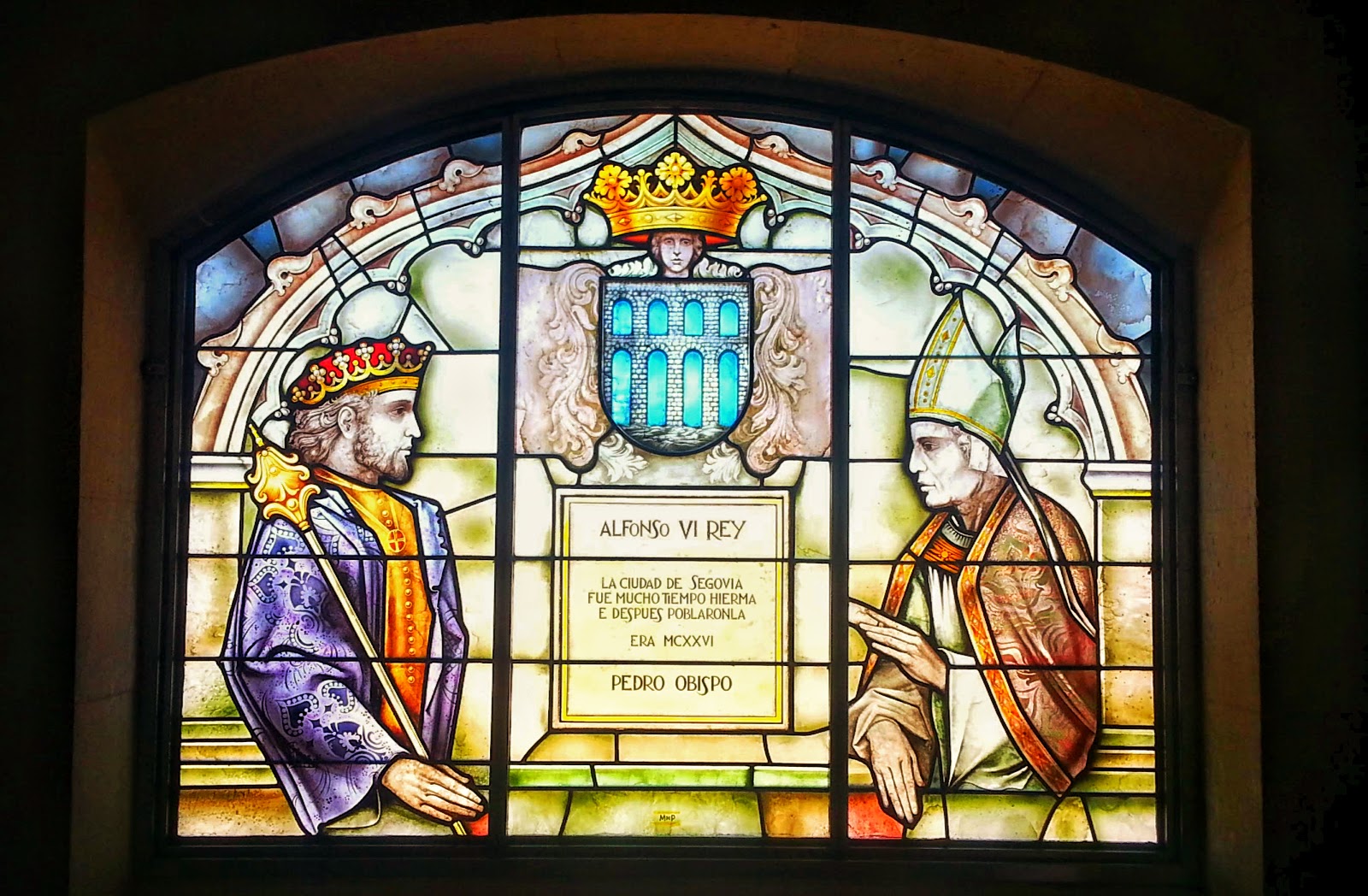
Then came the Sala de Cordon (the Cord Room), lined with Franciscan cords to represent Alfonso X’s penance for his excessive pride. Then we made our final stop within the confines of the palace - the chapel where Philip the II married his Anne of Austria. The chapel had, like many of the rooms, been renovated following the fire. However, it proudly displays a painting of the Epiphany by Bartolomé Carducho from 1600 that was rescued as the place burned to the ground. Like Dolly Madison saving the portrait of George Washington during her retreat from the White House in the War of 1812.
We had one more exciting adventure to take before settling in to a traditional Segovian lunch: climbing the tower of Juan II.
 |
| half way up the tower, there is an outlet for you to rest and see another incredible view of the castle towers and surroundings |
Our workout left us famished and we sought a restaurant to indulge in a Menú that would allow us a taste of the famous local cuisines. Jonny chose Meson don Jimeno, and we were able to try not only the famed - and absolutely delicious Roast Suckling Pig - but also traditional Castilian soup - which tasted like paprika water with chorizo, bread, and fat throughout. A word to the wiser travelers than us: we were very preoccupied with making sure we could see the palace and the cathedral before they closed to the public. This meant lunch closer to the average Spanish lunch time - 3:00. I think in retrospect it would have been a better idea to eat earlier, like 1:00. We probably would not have had to wait for over an hour to eat on a busy Saturday, and we still would have had all the necessary time to visit the Cathedral and Alcázar. Oh well, we had a few beers, a few tapas, and the meal was well worth the wait.
We circled the entire base of the castle’s foundation, finding random, un-preserved ruins here and there. As the sun began to set, we were scaling an uncountable number stairs to arrive at the top of the rock, on the opposite side of the castle from where we started. I need to be in better shape if I am going to keep up with the whims of my husband.


